
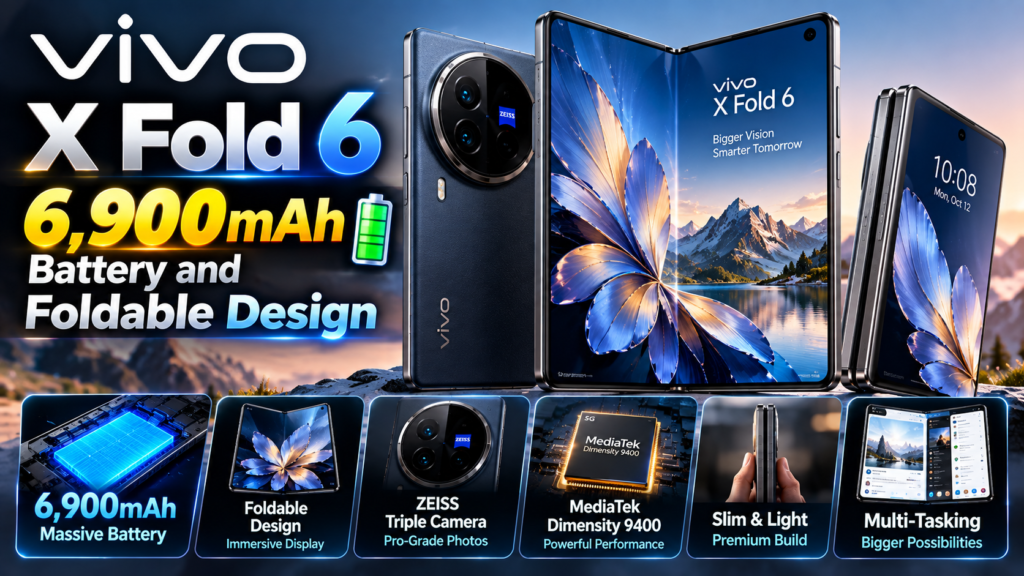
Battery life has always been the quiet weakness of book-style foldables — two screens and a hinge leave a lot less room for a big cell. Vivo’s answer this generation is simple: make the battery bigger than almost anyone else’s. The Vivo X Fold 6 launched globally on October 1, 2026, three months after its original China debut, and its headline spec is a 6,900mAh battery — the largest Vivo has ever packed into a foldable.
Here’s the full breakdown.
The battery: biggest in its class, with an asterisk
China’s 3C certification authority confirmed the dual-cell configuration behind that number: two cells rated 2,807mAh and 3,863mAh, combining for a rated 6,670mAh and a typical capacity of approximately 6,900mAh. That’s a meaningful 900mAh jump over the Vivo X Fold 5’s 6,000mAh cell, and it edges out both of its closest direct rivals — the Oppo Find N6 at 6,000mAh and the Honor Magic V6’s standard 6,850mAh configuration.
The asterisk: the Chinese domestic version of the X Fold 6 actually ships with a slightly larger 7,000mAh battery. The global version trims that down to 6,900mAh — a roughly 1.4% reduction Vivo hasn’t explained, but one small enough that early Chinese reviews of battery life should still translate closely to what international buyers actually get. Charging stays the same across both versions: 80W wired and 40W wireless.
Vivo backs up the real-world claim with its own benchmark: up to 9.37 hours of multitasking in the company’s Origin Workbench testing — a reasonable proxy for how the battery holds up under the kind of heavy, split-screen productivity use a foldable’s larger inner display is specifically built to encourage.
The displays: two 120Hz LTPO panels, built for productivity
The X Fold 6 uses an 8.02-inch 2K+ LTPO AMOLED inner display (2,504 x 2,312 resolution) paired with a 6.51-inch cover screen (2,528 x 1,120 resolution). Both panels support an adaptive 1-120Hz refresh rate, Dolby Vision, HDR10+, and up to 5,000 nits of peak brightness — genuinely flagship-tier specs on both sides of the fold, not just the main internal screen.
For context against its closest rivals: the inner display is marginally smaller than the 8.03-inch panel on its own predecessor, the X Fold 5, but larger than the 7.58-inch inner display on the Xiaomi 18 Fold — making screen size differences between this generation’s top foldables genuinely marginal, with camera processing and software increasingly the more meaningful differentiators.
The camera: 200MP main sensor with Zeiss tuning
The rear system is built around a 200MP primary sensor with OIS and Zeiss T* coating, joined by a 50MP ultrawide and a 50MP 3x periscope telephoto capable of up to 100x Zeiss HyperZoom. Both the inner and cover screens get their own 20MP selfie cameras, and the phone supports 4K 60fps Dolby Vision video recording. The Xiaomi 18 Fold also ships with a 200MP main camera under Leica branding, which means at this tier, the megapixel count has largely become table stakes — it’s processing, color science, and lens quality doing the actual differentiating now.
The chip and performance
Power comes from the 3nm MediaTek Dimensity 9500 Super Edition — a version of the standard Dimensity 9500 built specifically in partnership with Vivo, featuring more efficient cooling and higher neural processor performance than the baseline chip. The global model pairs this with 12GB of LPDDR5X RAM and 512GB of UFS 4.1 storage (non-expandable), though the Chinese domestic version offers a 16GB RAM option not currently confirmed for international markets.
Software: OriginOS 7 Fold, leaning hard into multitasking
The global version runs OriginOS 7 Fold, based on Android 17 — a step up from the OriginOS 6 the Chinese launch model shipped with. Vivo is positioning the whole package around productivity rather than just screen size: features include Multi-Split Screen (up to four apps at once), Origin Workbench, Desktop Mode, AI Cross-App Drag, an AI Meeting Assistant, and an AI File Manager — a clear signal that Vivo wants the X Fold 6’s large inner display treated as an actual productivity tool, not just a bigger canvas for watching video.
Build and durability
Vivo is marketing the X Fold 6 as slim despite its large battery, and backing that with real durability certifications: IPX8/IPX9 water resistance and IP5X dust protection — notably more robust dust protection than most book-style foldables typically offer, a category where dust ingress around the hinge has historically been a bigger practical concern than water exposure.
Pricing and availability
Vivo hasn’t published official global pricing across every market yet, but an Italian retail listing points to roughly €2,135. Pricing and specific memory configurations are expected to vary by region, with an India launch reportedly tipped for the days following the global announcement.
Where it actually stands out
The X Fold 6’s real pitch isn’t any single spec in isolation — it’s the combination: a battery that beats its closest direct competitors even after the global trim-down, flagship-level displays on both panels rather than a compromised cover screen, a camera system competitive with this generation’s best foldables, and a software layer specifically built around multi-app productivity rather than simply stretching a phone interface across a bigger screen. For buyers who’ve found past foldables compelling on paper but frustrating by evening due to battery anxiety, the X Fold 6’s 6,900mAh cell is a direct, specific answer to that exact complaint.
Leave a Reply