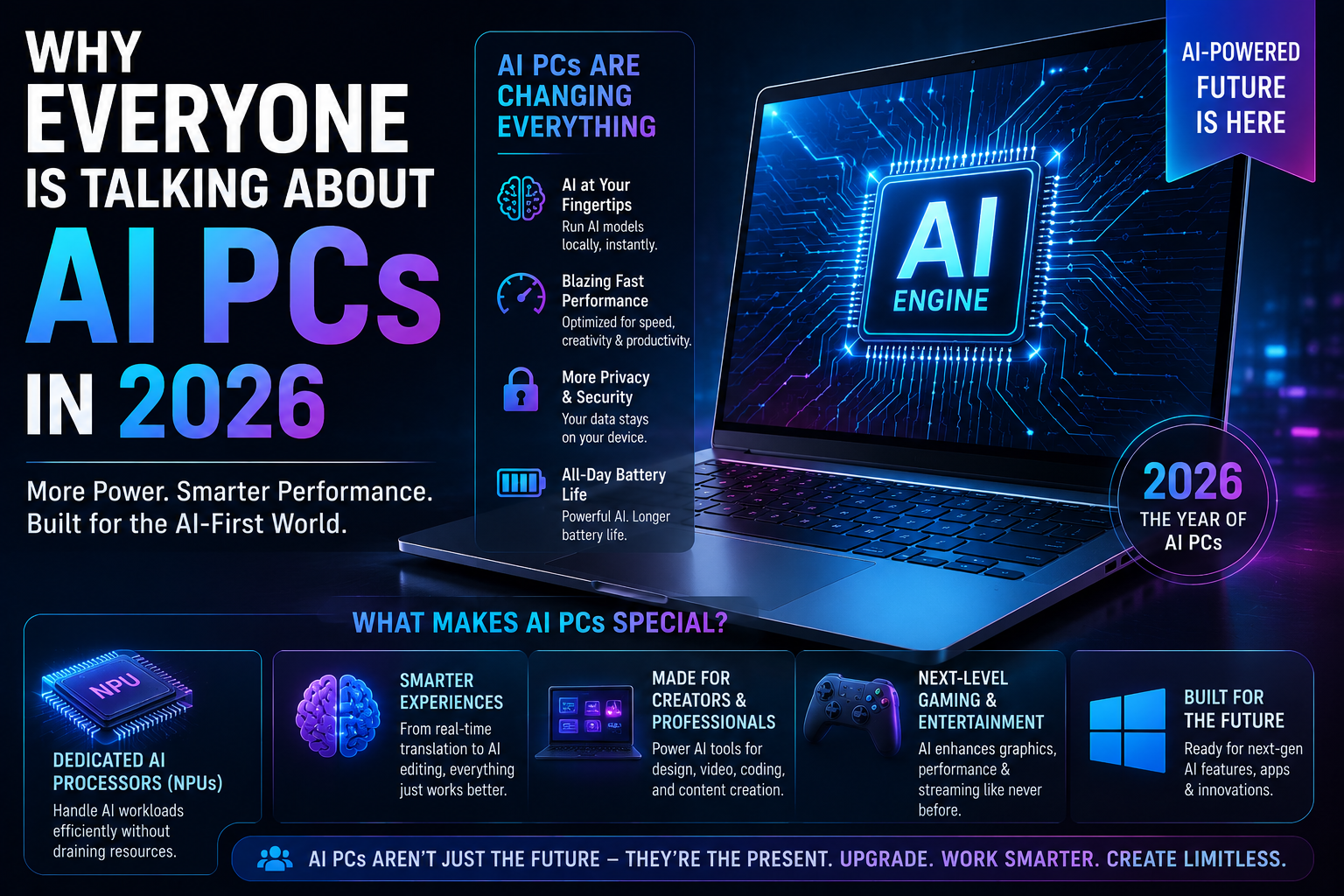
Walk into any electronics store in 2026 and nearly every laptop on the shelf is stamped with some variation of “AI PC,” “Copilot+ PC,” or “next-gen AI-powered” branding. The marketing is relentless, occasionally confusing, and — unlike a lot of tech buzzwords — actually attached to real hardware and real numbers this time. Here’s why this specific category has become impossible to avoid this year.
First, what actually counts as an “AI PC”
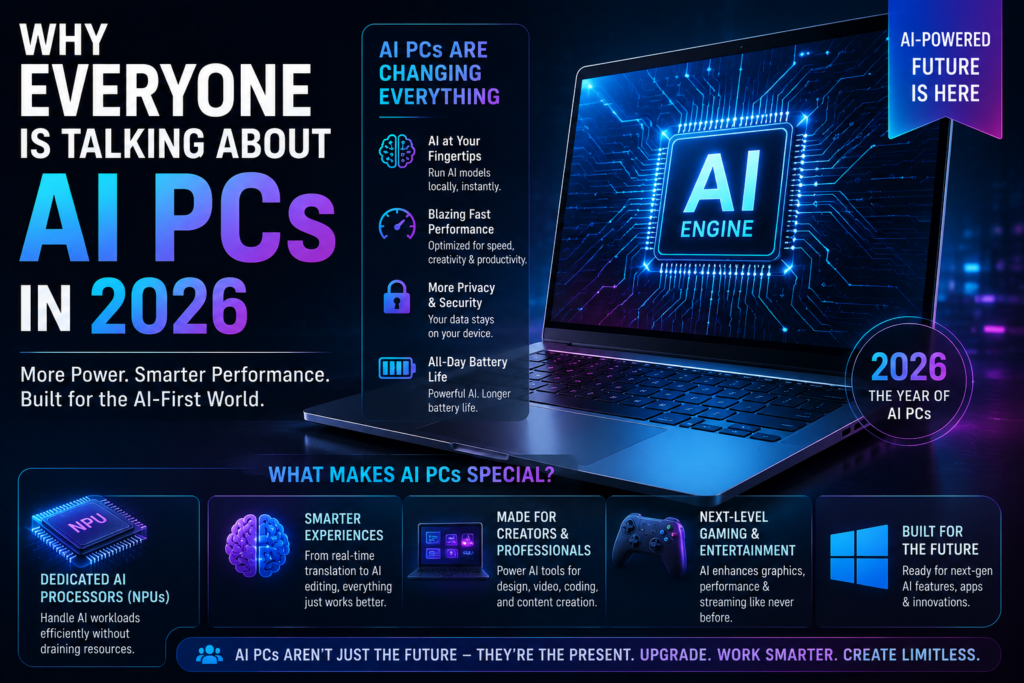
Depending on who’s counting, the definition shifts slightly. Broadly, an AI PC is a desktop or laptop with a dedicated Neural Processing Unit (NPU) — a chip built specifically to accelerate on-device AI workloads rather than routing them to the cloud. Microsoft’s specific “Copilot+ PC” branding requires an NPU capable of at least 40 TOPS (trillion operations per second) — currently available on Qualcomm’s Snapdragon X Elite/Plus chips and select AMD and Intel processors. Gartner’s commercial-market classification largely aligns with that same Copilot+ threshold.
The practical difference for a buyer: an AI PC can run certain generative AI features — background blur, live captioning and translation, image generation, local chatbot inference — directly on the device, without needing an internet connection or a cloud subscription behind it.
The number that explains the hype: nearly 6 in 10 new PCs
This is where the “everyone’s talking about it” part gets concrete. Gartner projects AI PCs will reach 55% of total global PC shipments by the end of 2026 — roughly 143 million units. Counterpoint Research puts the figure even higher, projecting AI-advanced PC penetration climbing to ~59% of global shipments in 2026, up sharply from about 39% in 2025. Intel executives have gone further still, predicting AI PCs will exceed 50% of the market this year and climb toward 80% by 2028.
Whatever the exact number lands on, the direction is unambiguous: within a year or two, “AI PC” stops being a premium category and becomes simply what a new computer is.
Windows 10’s death sentence is doing a lot of the heavy lifting
A huge chunk of this surge isn’t really about AI enthusiasm — it’s about a forced deadline. Windows 10 reached end of support on October 14, 2025, and Gartner estimated up to 400 million devices couldn’t upgrade to Windows 11 at all due to TPM 2.0, CPU, or Secure Boot hardware requirements. That created a genuinely unusual demand shock: millions of buyers facing a real security deadline, not just a marketing pitch, right at the exact moment vendors were pivoting their entire premium lineup toward NPU-equipped hardware.
The result was a lumpy but real shipment rebound through late 2025 and into early 2026 — global shipments rose 3.2% year-over-year in Q1 2026 to about 63.3 million units — but even the analysts tracking the growth are cautious about calling it healthy. It looks more like a one-time replacement wave running into a separate, less convenient story: memory prices.
The uncomfortable part: this boom is happening during a price squeeze
Here’s the tension nobody selling you an AI PC particularly wants to highlight. The same AI boom driving demand for NPU-equipped laptops is also driving up the cost of building them. Hyperscalers and cloud AI providers are prioritizing wafer and packaging capacity for server-grade DDR and HBM memory, which has tightened supply — and driven up prices — for the ordinary DRAM and NAND flash that goes into consumer laptops.
That’s part of why some longer-term projections are actually bearish on total PC volume even as the AI PC share climbs: one industry estimate has total global PC shipments falling from roughly 297 million units in 2025 to 255 million in 2026 — a 14% decline — even as AI PCs make up a larger and larger slice of that shrinking pie. In plain terms: fewer total computers are expected to sell this year, but a much bigger share of the ones that do sell will be AI-capable, and they’ll likely cost more than last year’s equivalent model.
Apple’s quiet head start
One detail that tends to get lost in all the Copilot+ marketing noise: Apple has been shipping NPU-equivalent silicon in its M-series chips for years, and that head start shows up clearly in the AI PC segment specifically. By share of the AI PC category alone — not the overall PC market — Apple reportedly holds around 45%, despite commanding only roughly 9–10% of the overall PC market. In other words, on-device AI acceleration was already standard in every new Mac well before “AI PC” became an industry-wide marketing category for Windows machines to catch up to.
Why the software side is still catching up to the hardware
Buying the hardware and actually using the AI features are turning out to be two different things. Take Microsoft Copilot, the software layer most closely tied to the Copilot+ PC branding: despite deep integration across Windows, Edge, and Microsoft 365, and over 450 million commercial Microsoft 365 seats to sell into, Microsoft 365 Copilot had reached about 20 million paid enterprise seats by Q3 FY26 — real growth, and the fastest quarterly seat growth Microsoft has reported since launch, but still a modest fraction of the available install base. Worse for the “everyone’s using this” narrative: independent trackers have put actual workplace activation rates as low as 35.8% even among people with a paid seat.
That gap — hardware capable of running AI everywhere, software adoption still working out what people actually want to do with it — is arguably the real undercurrent of the AI PC story in 2026. The chips shipped faster than the compelling use cases did.
Who’s actually buying, and why
The clearest adoption pattern by far is commercial, not consumer. Businesses facing the Windows 10 deadline, needing new hardware anyway, and wanting to get ahead of an AI-driven productivity shift have been the primary driver of AI PC volume so far — Gartner data shows laptops reaching meaningfully higher AI PC penetration than desktops, since NPUs deliver the clearest benefit (battery efficiency from on-device processing) in thin-and-light business laptops first. Consumers, by contrast, have been slower to see a must-have reason to pay the AI premium — a familiar pattern for a lot of AI-branded hardware over the past few years.
The bottom line
AI PCs are dominating tech conversation in 2026 for a genuinely rare combination of reasons: a real, forced upgrade deadline (Windows 10’s retirement), a real hardware shift (NPUs becoming standard rather than niche), and real, large numbers behind the shipment share (over half of new PCs this year). What’s less settled is whether the software running on all that new silicon has actually caught up to justify it yet — for now, a lot of buyers are getting AI-capable hardware because they needed a new computer anyway, not because a specific AI feature convinced them they couldn’t live without it. That gap between hardware readiness and software payoff is likely to be the real story to watch through 2027.
Leave a Reply