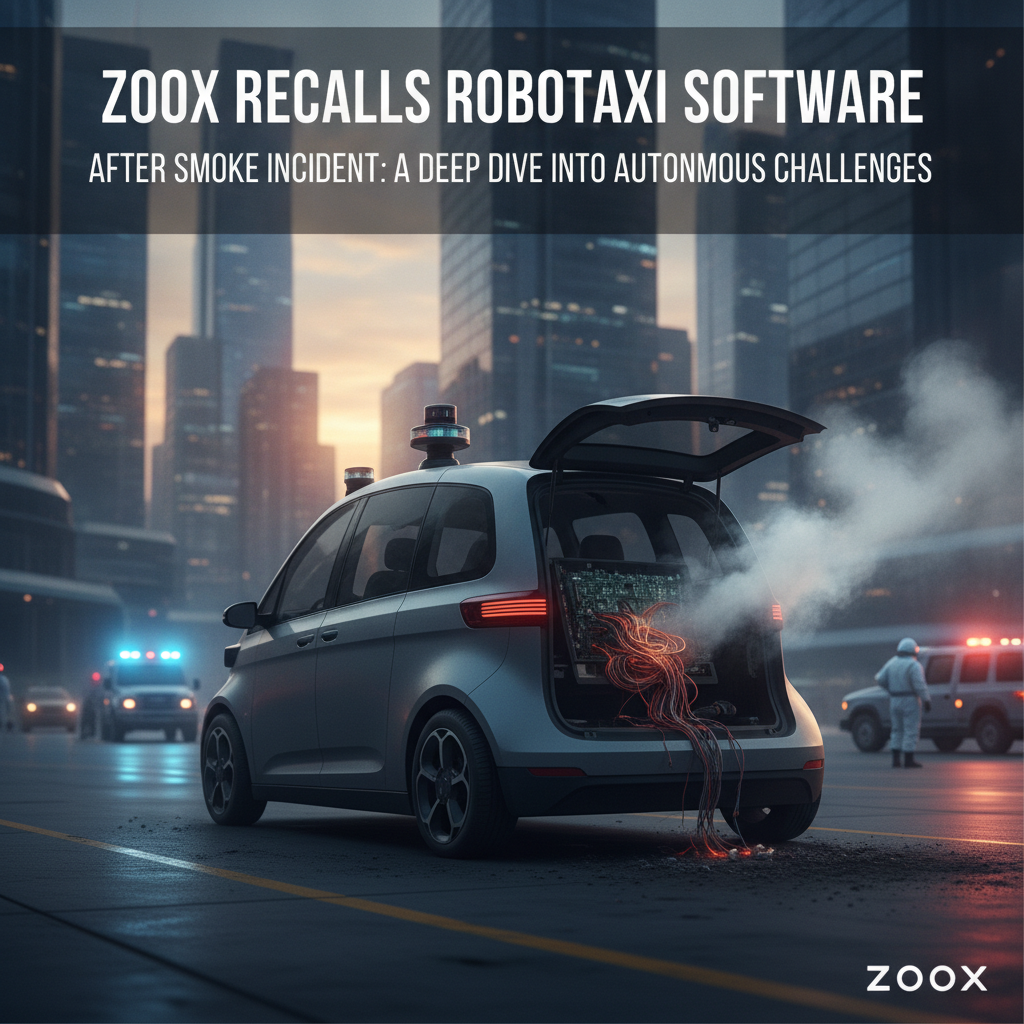
The road to fully autonomous vehicles is paved with innovation, but also with unforeseen challenges. In a significant development for the self-driving industry, Zoox, the Amazon-owned robotaxi company, has announced a software recall following an incident where one of its autonomous vehicles became disoriented by heavy smoke. This event underscores the complex environmental hurdles that autonomous systems must navigate and highlights the continuous learning curve in developing truly robust self-driving technology.
The Incident: When Smoke Obscured Clarity for a Zoox Robotaxi
The recall stems from a recent event where a Zoox robotaxi encountered an area dense with smoke, reportedly from a nearby brush fire or industrial incident. While human drivers are trained to react to reduced visibility with caution, the Zoox vehicle’s advanced sensor suite – typically adept at perceiving its surroundings – struggled to accurately interpret the environment. Sources close to the incident indicate the vehicle exhibited hesitant, confused behavior, prompting intervention from remote operators and leading to an immediate investigation by Zoox’s engineering teams.
This particular scenario highlighted a critical vulnerability: how extreme environmental anomalies, like heavy smoke, can disrupt the intricate interplay of lidar, radar, and camera systems, leading to a breakdown in the AI’s situational awareness and decision-making algorithms.
Zoox’s Proactive Response: A Targeted Software Recall
In response, Zoox has initiated a targeted software recall, demonstrating its commitment to safety and rapid iteration. The recall specifically addresses an identified deficiency in the software’s ability to accurately process and interpret sensor data under conditions of severely obscured visibility, such as heavy smoke or dense fog. The update aims to enhance the vehicle’s perception stack, allowing it to better recognize and react to such challenging atmospheric conditions.
While the specifics of the software patch remain proprietary, it is expected to involve improvements in:
- Sensor Fusion Algorithms: Better integration and weighting of data from different sensor types when one or more are compromised.
- Environmental Anomaly Detection: More sophisticated recognition of elements like smoke, dust storms, or heavy precipitation.
- Fail-Safe Protocols: Enhanced logic to initiate safer, more conservative maneuvers (e.g., slowing down, pulling over safely, or requesting human assistance) when perception uncertainty is high.
This recall, administered via an over-the-air (OTA) update, is a testament to the agile development cycle common in the tech industry and crucial for autonomous vehicles. It allows for rapid deployment of fixes without the logistical complexities of physical vehicle recalls.
Beyond Zoox: Broader Implications for Autonomous Vehicle Safety
This incident and subsequent recall are not unique to Zoox but rather illuminate a universal challenge for the entire autonomous vehicle industry. While AVs excel in predictable conditions, their true test lies in mastering the unpredictable chaos of real-world environments. Heavy smoke, blizzards, torrential rain, and unexpected debris present scenarios that push the boundaries of current AI and sensor technology.
The Zoox incident serves as a vital reminder that:
- Perception is Paramount: The ability of AVs to “see” and understand their surroundings is the foundation of safety.
- Edge Cases are Everywhere: Designing for every conceivable “edge case” (rare, extreme events) is incredibly difficult but essential.
- Continuous Improvement is Key: Autonomous driving is an iterative process, with each incident providing critical data for refinement and safety enhancements.
- Transparency Builds Trust: Zoox’s proactive communication and recall, though stemming from a hiccup, can ultimately help build public confidence in the industry’s commitment to safety.
Moving Forward: Enhancing Robustness and Public Trust
For Zoox, this software recall represents a necessary step in hardening its autonomous system against a broader spectrum of environmental challenges. The company is expected to intensify its testing protocols in diverse and challenging conditions, potentially incorporating simulated smoke scenarios and real-world obscured visibility tests.
As robotaxi services expand, incidents like these are inevitable. What truly defines the progress of autonomous technology is how rapidly and effectively companies like Zoox learn from these events, implement solutions, and communicate their commitment to safety. The goal remains the same: to deliver a transportation solution that is not just convenient, but fundamentally safer than human-driven alternatives, even when faced with the unexpected.
Conclusion
The Zoox software recall due to a robotaxi’s confusion by heavy smoke is a potent reminder of the ongoing complexities in the race for full autonomy. It highlights the critical need for resilient AI, advanced sensor technology, and a steadfast dedication to safety protocols that can handle the full spectrum of real-world conditions. As Zoox rolls out its updated software, the industry watches, learning invaluable lessons that will ultimately contribute to a more reliable and secure future for self-driving vehicles.