Google’s next smartwatch is shaping up to be less about a new look and more about what’s happening on the software side. Leaked marketing materials, official renders, and a wave of pre-launch coverage all point to the same headline: the Pixel Watch 5, expected to debut August 12 alongside the Pixel 11 lineup, is being built around Gemini as its core selling point. But there’s a catch buried in the specs that’s worth understanding before getting too excited.
The pitch: an assistant that lives on your wrist
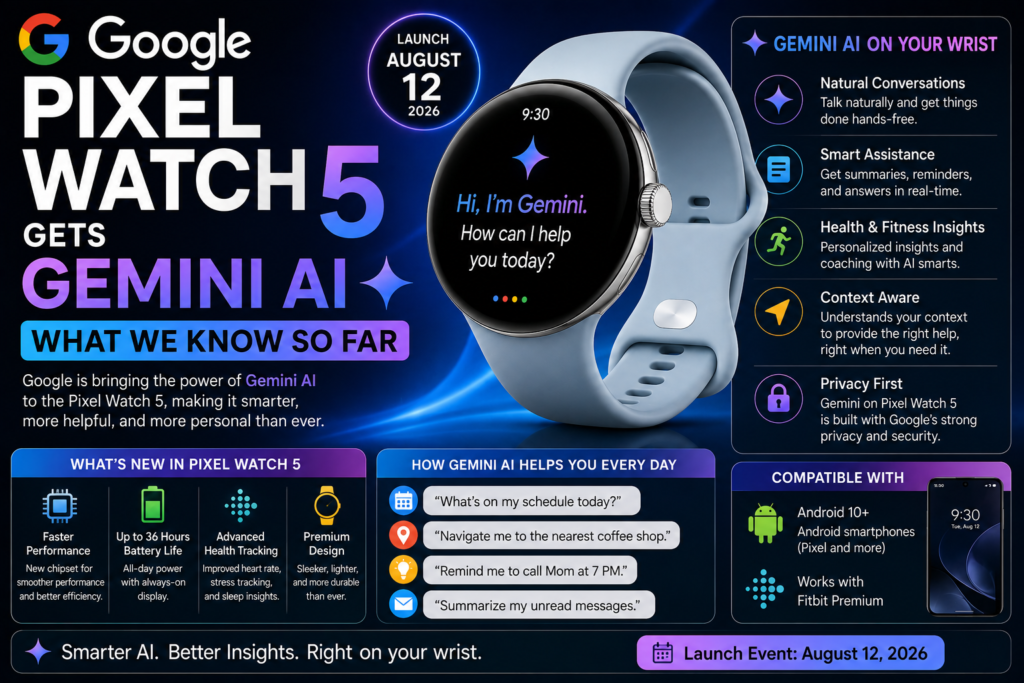
Leaked promotional material describes Gemini on the Pixel Watch 5 as an intelligent assistant designed to anticipate your needs, proactively surface helpful information, and provide contextual assistance throughout the day — all without reaching for your phone. Leaked UI renders show a dedicated “Ask Gemini” element built directly into the watch face, offering hands-free, conversational AI access at a glance.
What Gemini actually looks like in the interface
Several leaks have shown specific examples of what this looks like in practice:
- Dedicated Gemini watch faces with quick-access shortcuts to trigger voice actions, summarize your daily agenda, or ask contextual questions.
- An “Ask Coach” widget, letting users pose natural-language questions like “Do I sleep better on days when I get more steps?” and receive tailored analysis comparing sleep and activity data.
- Smarter message replies — improved on-device language processing meant to draft more natural, context-aware quick replies to notifications.
- Multi-step app automation, letting users build custom task sequences to streamline routines.
- System-wide Gemini overlays running on Wear OS 7, the operating system the watch ships with out of the box.
The hardware behind it — and the catch
Here’s where the story gets more complicated. Multiple leaks now indicate the Pixel Watch 5 will keep the same Snapdragon W5 Gen 2 chipset used in the previous generation, rather than moving to a newer chip with dedicated AI hardware. What is changing is memory: RAM is reportedly jumping from 2GB to 3GB, and storage is doubling to 64GB — upgrades clearly aimed at giving on-device AI more room to run.
But there’s a real technical distinction worth understanding. The Snapdragon W5 Gen 2 includes a general-purpose co-processor for always-on sensing tasks — heart rate monitoring, step counting, wake-word detection — but it lacks a dedicated neural processing unit (NPU) built specifically for generative AI, the kind found in some competing wearable chipsets. That means any Gemini features running locally on the watch would be processed on general-purpose CPU cores rather than specialized AI silicon — a setup that’s typically less power-efficient. Google’s implicit counter to this is the extra RAM, which allows a larger AI model to stay loaded in memory, but whether that fully offsets the lack of dedicated AI hardware in real-world battery life remains to be seen once the watch is actually in reviewers’ hands.
The bigger catch: Gemini Intelligence may not even be there at launch
Perhaps the most important detail buried in the leaks: reporting suggests Google has confirmed that the most heavily marketed Gemini Intelligence features are being deferred to “later in 2026,” with no specific date attached — meaning they may not actually be available when the watch starts shipping around August 20. If accurate, that would mean the feature getting top billing in Google’s own marketing materials isn’t fully functional on day one, with a software update expected to unlock it at some later point.
Health features are getting a real AI-adjacent upgrade too
Beyond the assistant features, health tracking is getting a substantial boost that ties into the same AI push:
- Loss of pulse detection, building on existing heart-rate monitoring, with automatic notification to emergency contacts or services if triggered.
- Heart rate variability (HRV) tracking for baseline stress resilience monitoring, plus irregular-rhythm notifications.
- What Google is calling its most accurate sleep tracking yet — detailed stage breakdowns (Deep, REM, Light, Awake), daily sleep quality scores, and qualitative summaries.
- Fitbit Personal Health Coach integration, continuing the “Ask Coach” feature Google introduced last year.
- On-device AI that analyzes activity patterns to suggest routine adjustments and deliver more context-aware notifications, including real-time feedback during workouts.
Design: intentionally unchanged
If you’re expecting a visual overhaul, leaks suggest you’ll be disappointed — Google appears to be keeping the same minimalist, dome-glass silhouette, tactile side crown, and proprietary band mechanism as the outgoing model. The strategy here looks deliberate: spend the update budget on software and AI capability rather than a redesign, on the logic that the current form factor already works.
Will older Pixel Watches get any of this?
Some reporting suggests Google may extend at least some Gemini Intelligence features to older Pixel Watch models via future software updates, rather than making it a Pixel Watch 5 exclusive forever — though as with the Watch 5’s own rollout timing, no specifics have been confirmed.
The takeaway
The Pixel Watch 5 is clearly being built and marketed around Gemini as its defining feature — but the actual on-device AI hardware looks more like an incremental RAM bump than a purpose-built AI chip, and the headline software feature itself may arrive after the watch does, not with it. If Gemini on your wrist is the reason you’re considering this watch, it’s worth waiting for Google’s official August 12 confirmation of both the hardware specifics and, critically, the actual availability timeline — rather than assuming the marketing pitch and the launch-day reality are the same thing.
All details above come from pre-launch leaks and unofficial reporting, not confirmed Google announcements. Treat specifics — especially the Gemini feature timeline — as unverified until Google’s own event.