
Artificial intelligence is changing the technology industry, and powerful computer chips are at the center of this transformation. From AI chatbots and image generators to self-driving technology and advanced data centers, modern AI systems need enormous computing power.
Two companies playing a major role in this competition are Nvidia and AMD.
Nvidia is known for its powerful GPUs and CUDA software ecosystem, while AMD is competing with its Instinct AI accelerators, advanced processors, and open software approach.
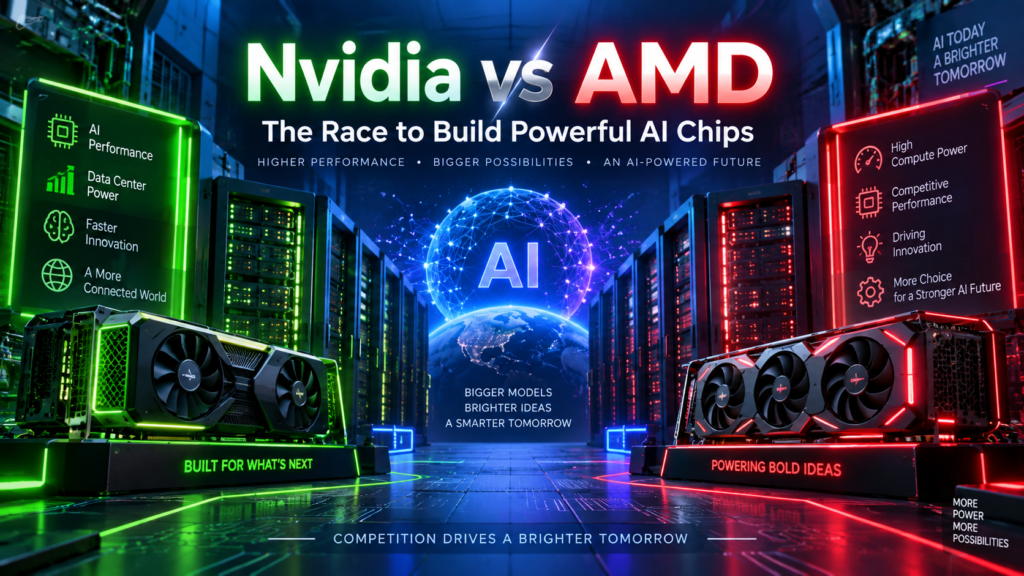
The competition between Nvidia and AMD is not just about making faster chips. It is also about memory, software, energy efficiency, data center infrastructure, and helping businesses run AI applications.
In this article, we explore the Nvidia vs AMD AI chip race and what it means for the future of artificial intelligence.
What Are AI Chips?
AI chips are specialized processors designed to handle the mathematical calculations used by artificial intelligence.
Traditional CPUs are excellent for general-purpose computing. However, AI workloads often require large numbers of calculations to happen simultaneously.
GPUs and AI accelerators are designed to handle these workloads efficiently.
AI chips are used for:
- Training large AI models.
- Running AI chatbots.
- Generating images and videos.
- Processing speech and language.
- Powering data center applications.
- Supporting scientific research.
As AI models become more advanced, the demand for powerful computing hardware continues to grow.
Nvidia: A Major Force in AI Computing
Nvidia has become one of the most recognizable names in AI hardware.
The company’s GPUs are used in data centers, research labs, cloud computing platforms, and AI development environments.
Nvidia’s AI hardware strategy includes GPUs, high-speed networking, CPUs, and complete data center systems.
Nvidia Blackwell
Nvidia’s Blackwell platform is designed for demanding AI and accelerated computing workloads.
Blackwell-based systems are intended to support large-scale AI model training and inference.
Training involves teaching an AI model using data. Inference is the process of using a trained model to generate answers or predictions.
Both require powerful hardware, especially when AI models are used by millions of people.
Nvidia Rubin
Nvidia has also announced its next-generation Rubin architecture.
The Rubin platform is part of Nvidia’s future AI computing roadmap and is designed to continue improving performance for advanced AI workloads.
The company’s strategy focuses on combining computing power, memory, networking, and software into complete AI systems.
AMD: The Challenger in AI Chips
AMD is another important company in the AI chip industry.
Its Instinct accelerator family is designed for data center AI and high-performance computing.
AMD is competing by offering powerful hardware and expanding its software ecosystem for AI developers.
AMD Instinct
AMD Instinct accelerators are built for workloads such as:
- AI model training.
- AI inference.
- Scientific computing.
- High-performance computing.
- Large-scale data center applications.
AMD’s approach includes using advanced chiplet designs and high-bandwidth memory to support demanding workloads.
AMD Helios
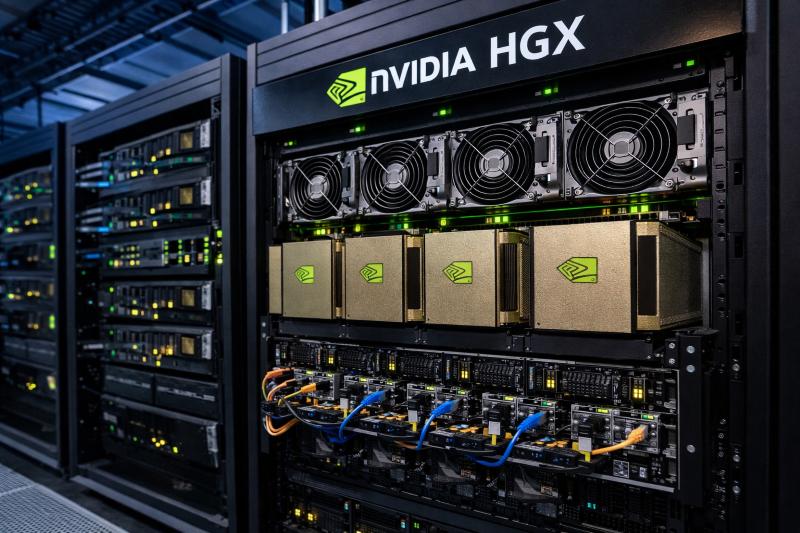
AMD has also introduced its Helios AI rack platform.
Helios is designed to combine multiple AI accelerators into larger systems for demanding data center workloads.
This shows that the AI chip competition is moving beyond individual processors. Companies are increasingly building complete AI infrastructure.
Nvidia vs AMD: Key Differences
1. AI Performance
AI performance depends on many factors, including chip architecture, memory bandwidth, software optimization, and the workload being tested.
Nvidia and AMD both develop high-performance AI accelerators.
A chip that performs well for AI training may not necessarily be the best option for every inference workload.
For this reason, businesses usually evaluate specific benchmarks rather than relying only on brand names.
2. Software Ecosystem
Software is one of the most important parts of the AI chip competition.
Nvidia’s CUDA ecosystem is widely used by AI developers and researchers. It provides tools and libraries that help developers use Nvidia GPUs.
AMD supports AI development through ROCm, its open software platform for GPU computing.
The availability of software libraries, developer tools, and framework support can affect how easily an AI model runs on a particular chip.
3. Memory and Data Transfer
AI models often require large amounts of memory.
High-bandwidth memory, commonly called HBM, is important for many advanced AI accelerators.
Fast memory allows processors to access large amounts of data quickly.
Nvidia and AMD both use advanced memory technologies in their AI hardware strategies.
4. Data Center Infrastructure
Modern AI systems need more than individual chips.
They also require:
- High-speed networking.
- Cooling systems.
- Power delivery.
- Storage.
- Software management.
- Communication between processors.
Nvidia and AMD are both expanding their focus toward complete data center solutions.
This is important because large AI models may run across many processors at the same time.
Why Nvidia and AMD Are Competing So Hard
The growth of generative AI has created demand for powerful computing infrastructure.
Companies developing AI assistants, image generators, video tools, and enterprise software need access to large amounts of computing power.
This creates opportunities for chip manufacturers.
Nvidia has a strong position in AI computing, while AMD is working to expand its presence with new accelerators and data center platforms.
The competition is also encouraging innovation in hardware design, software, memory, and energy efficiency.
AMD’s Growing AI Ambitions
AMD has been expanding its AI strategy through new accelerator products and data center platforms.
In 2026, AMD announced new AI infrastructure developments, including its Helios platform and next-generation data center hardware.
These announcements show AMD’s focus on competing in large-scale AI computing.
The company is also working to strengthen its software ecosystem so developers can build and run AI applications on AMD hardware.
Nvidia’s Expanding AI Ecosystem
Nvidia is expanding beyond individual GPUs.
Its AI strategy includes complete computing platforms, networking technologies, and software tools.
The company’s NVLink technology is designed to support high-speed communication between processors.
This kind of connectivity becomes increasingly important as AI systems use larger numbers of chips.
Nvidia’s expansion into complete AI infrastructure is part of the wider shift toward large-scale AI data centers.
What Does This Mean for AI Users?
The competition between Nvidia and AMD could have several effects on the technology industry.
More Computing Power
As chip companies develop new architectures, AI developers gain access to more powerful hardware.
This can help support larger models and more complex applications.
More Hardware Choices
Businesses may have more options when selecting AI accelerators.
Different chips can be suitable for different workloads, budgets, and software environments.
Innovation in AI Software
Hardware competition can encourage improvements in software tools and frameworks.
Better software optimization can help developers use computing resources more effectively.
Data Center Growth
AI demand is driving investment in data centers, networking, and power infrastructure.
The AI chip race is therefore connected to the broader growth of cloud computing and enterprise technology.
The Challenges Ahead
Building powerful AI chips is not easy.
Manufacturers must deal with several challenges.
Manufacturing Complexity
Advanced AI chips require sophisticated semiconductor manufacturing and packaging.
The production process can be expensive and technically demanding.
Energy Consumption
Large AI data centers consume significant amounts of electricity.
Improving energy efficiency is important for reducing operating costs and supporting sustainable growth.
Memory Supply
AI accelerators rely on advanced memory technologies.
Memory availability and packaging capacity can affect the production of high-performance AI systems.
Software Compatibility
Developers need reliable software tools to run AI workloads efficiently.
A powerful chip is less useful if the required software support is limited.
Nvidia vs AMD for Gaming AI
Although this article focuses on AI chips for data centers, Nvidia and AMD are also major players in gaming graphics.
Their consumer GPUs support features such as:
- AI-assisted image upscaling.
- Frame generation.
- Ray tracing.
- Game graphics acceleration.
However, data center AI accelerators and gaming GPUs are designed for different types of workloads.
A graphics card designed for gaming is not automatically the best choice for training a large AI model.
The Future of AI Chips
The AI chip industry is expected to continue developing rapidly.
Future AI hardware may focus on:
- Faster AI model training.
- More efficient AI inference.
- Larger memory capacity.
- Better energy efficiency.
- Improved chip-to-chip communication.
- More advanced AI software.
- Specialized processors for specific workloads.
Nvidia and AMD are both investing in technologies that support these goals.
Other companies, including Google, Amazon, and specialized chip startups, are also developing AI hardware.
This means the AI chip market is becoming increasingly competitive.
Conclusion
The Nvidia vs AMD AI chip race is an important part of the artificial intelligence revolution.
Nvidia brings its established GPU and software ecosystem, while AMD is expanding its Instinct accelerator lineup and AI infrastructure strategy.
Both companies are working to improve computing performance, memory, software, and data center capabilities.
For AI developers and businesses, the most important factors will include workload performance, software compatibility, cost, availability, and energy efficiency.
As artificial intelligence continues to grow, the competition between Nvidia and AMD will remain an important story in the technology industry.
Follow Tech Nexa for more AI news, GPU updates, gaming technology, and the latest developments in the world of computing.
Frequently Asked Questions
1. What is the difference between Nvidia and AMD AI chips?
Nvidia and AMD both develop processors for AI computing. Nvidia is known for its CUDA ecosystem, while AMD offers Instinct accelerators and ROCm software.
2. Are Nvidia AI chips better than AMD?
Performance depends on the specific chip, workload, software, and system configuration. There is no single chip that is best for every AI task.
3. What are Nvidia Blackwell and AMD Instinct?
Blackwell is a Nvidia AI computing platform. AMD Instinct is a family of AI accelerators designed for data center and high-performance computing workloads.
4. Why are AI chips important?
AI chips help computers perform the large numbers of calculations required for training and running artificial intelligence models.
5. Will AI chip competition affect the future?
Competition can contribute to improvements in computing hardware, software, efficiency, and the availability of AI infrastructure.