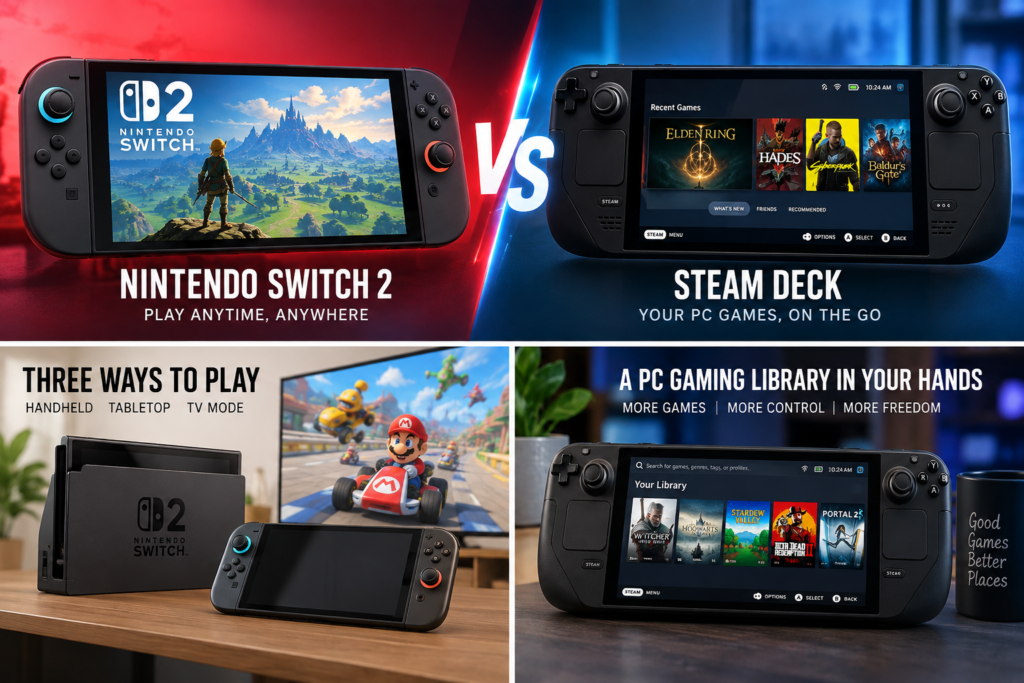
The Nintendo Switch 2 and Steam Deck represent different gaming handhelds.
The Nintendo Switch 2 is a console based gaming experience focused on Nintendos games and a simple console feel. Steam Deck is essentially a PC for games running SteamOS and giving access to a huge PC game library.
The Switch 2 launched in June 2025 while Steam Deck originally launched in 2022.
Design and Portability
Nintendo Switch 2 is designed to work in three ways: handheld mode, tabletop mode and TV mode, Joy-Con 2 controllers can be detached making multiplayer gaming easier the console weighs around 535g with the controllers.
Steam Deck is larger and heavier weighing around 669g for the LCD model, controls are permanently attached to the device although it includes additional controls such as trackpads and rear buttons.
The Switch 2 is therefore more similar to a console that can be carried around while Steam Deck feels more like a portable PC.
Display Comparison
The Switch 2 has a 7.9-inch LCD display with 1920 × 1080 resolution and support for refresh rates up to 120Hz, also supports HDR and variable refresh rate in mode.
Steam Deck has display options depending on the model, the original LCD version has a 7-inch 1280 × 800 display, the Steam Deck OLED has a 7.4-inch 1280 × 800 HDR OLED display with refresh rates up to 90Hz.
The two displays have strengths:
Switch 2
Higher resolution
Larger display
Up to 120Hz
HDR
VRR support
Steam Deck OLED
OLED technology
Strong contrast
HDR
Up to 90Hz
black levels
So the choice depends on whether you prefer higher resolution and refresh-rate capability or an OLED panel.
Performance
The Switch 2 uses a custom NVIDIA processor while Steam Deck uses a custom AMD processor based on Zen 2 and RDNA 2 technology.
Switch 2 also supports NVIDIAs DLSS technology which can help games produce resolution-looking images while maintaining performance.
Steam Deck uses AMD graphics technology, can make use of features such as FSR in supported games.
Performance is difficult to compare using specifications as the two systems run different operating systems and games are optimized differently.
Some demanding games have been adapted for Switch 2 while Steam Deck gives players access to PC games with adjustable graphics settings.
Game Library
This is one of the differences, Nintendo Switch 2 provides access to Nintendos first-party games and a growing collection of third-party titles, its library includes franchises such as Mario, Zelda, Pokémon and other Nintendo properties, it also supports Switch games although compatibility can vary for individual titles.
Steam Deck provides access to the Steam ecosystem, players can use their existing Steam library although not every PC game works perfectly on SteamOS.
Steam Deck is particularly flexible for PC gaming as users can adjust graphics settings and use software and accessories.
Controls
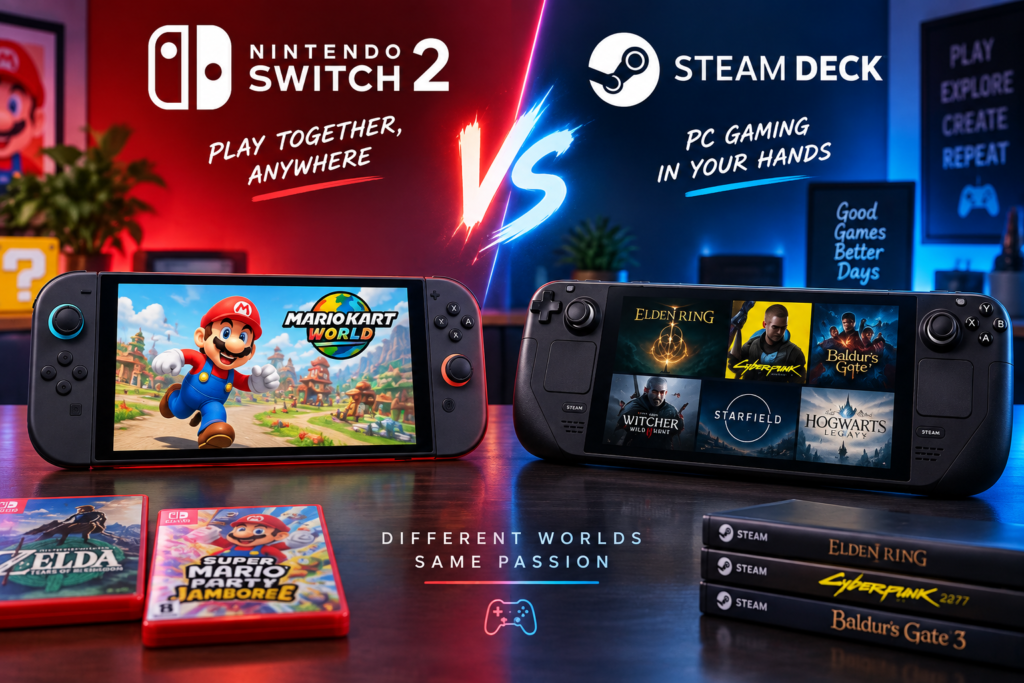
Nintendo focuses on simplicity with Joy-Con 2 controllers and the Pro Controller.
The Joy-Con 2 controllers can be removed from the console, used separately this makes local multiplayer convenient.
Steam Deck has:
Analog sticks
D-pad
ABXY buttons
Shoulder buttons
Trackpads
Rear buttons
Gyroscope
The trackpads are particularly useful for games designed around mouse controls.
Steam Deck also offers opportunities to customize controls which can be useful for PC games with complicated control schemes.
Storage
Nintendo Switch 2 includes 256GB of storage and supports compatible microSD Express cards for expansion.
Steam Deck models use NVMe SSD storage with capacities depending on the model, Steam Deck OLED is available with storage options than the original entry-level Deck.
This matters as modern games can take up a lot of storage space.
Steam Deck users also have the advantage of PC-style flexibility when managing their game library and storage.
Battery Life
Battery life depends heavily on the game, brightness, settings and system model.
The original Steam Deck can provide battery results depending on the workload while the Steam Deck OLED generally improves battery efficiency.
Switch 2s battery life also varies depending on the game and system usage.
For both devices demanding 3D games can use more power than simple 2D games.
If you regularly travel, carrying a charger or power bank can be useful.
TV and Docked Gaming
The Switch 2 is designed as a console, its dock is. Allows the system to connect to a TV.
This makes it easy to switch between handheld and television gaming.
Steam Deck can also connect to a TV or monitor, a separate dock or compatible USB-C hub is generally needed for a similar setup.
For someone who frequently switches between handheld and TV gaming, the Switch 2s integrated console approach is particularly convenient.
Software and Customization
Nintendo keeps its operating system simple, you turn on the console select a game and start playing.
Steam Deck offers more PC-like flexibility.
SteamOS provides a console-style interface, users can also access a desktop environment and change many system and game settings.
Steam Deck can therefore appeal to players who enjoy:
Custom controls
Graphics settings
PC applications
compatibility options
Desktop functionality
Modding where supported
The extra flexibility can also mean more setup and troubleshooting.
Price and Value
Pricing changes by region and model, the Switch 2 was listed at $449.99 in the United States before a scheduled increase to $499.99 from September 1 2026.
Steam Deck pricing depends on the LCD or OLED model and current availability.
The total cost of ownership also depends on the games you buy, Nintendo and PC games have pricing structures, sales patterns and editions.
Therefore comparing the initial hardware price does not tell the whole story.
Which One Fits Gamers?
Nintendo Switch 2
The Switch 2 is designed for players who want:
Nintendo-exclusive games
Simple console operation
Handheld and TV gaming
Detachable controllers
Local multiplayer
A high-resolution handheld screen
Steam Deck
Steam Deck is designed for players who want:
PC gaming on the go
Their Steam library
More graphics settings
Customizable controls
Desktop functionality
A more flexible gaming environment
Neither device has to replace the other, they target types of gaming experiences.
Nintendo Switch 2 vs Steam Deck
Nintendo Switch 2 and Steam Deck take approaches to portable gaming.
Switch 2 focuses on a console experience Nintendo games, detachable controllers and easy TV connectivity. Steam Deck focuses on PC gaming, Steam libraries, customization and greater software flexibility.
The Switch 2 offers a 1080p 120Hz- LCD display and the Steam Deck OLED offers a 7.4-inch HDR OLED display at 1280 × 800 and up, to 90Hz.
The biggest difference is therefore not hardware, it is the gaming ecosystem, Nintendo Switch 2 is built around Nintendos console ecosystem while Steam Deck brings much of the flexibility of PC gaming into a device.