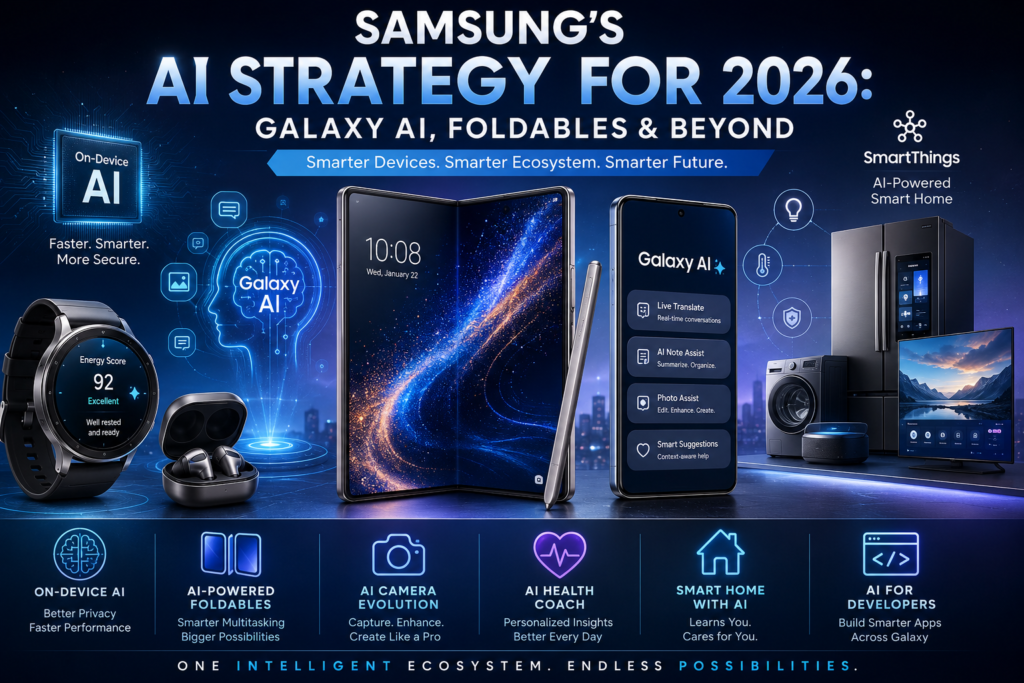
Artificial Intelligence is no longer just a software feature—it’s becoming the heart of modern consumer technology. Samsung has positioned itself as one of the industry’s biggest AI innovators, integrating intelligent features across smartphones, foldable devices, tablets, wearables, TVs, home appliances, and even future XR experiences.
As we move through 2026, Samsung’s AI strategy is becoming clearer than ever. Rather than building standalone AI products, the company aims to create a connected ecosystem where every Galaxy device works together intelligently.
Here’s a deep dive into Samsung’s AI vision for 2026 and what users can expect from Galaxy AI, foldable devices, smart homes, and beyond.
Galaxy AI Is Becoming the Core of Samsung Devices
Samsung introduced Galaxy AI to bring practical AI features into everyday life. Instead of focusing on experimental AI, Samsung emphasizes tools that help users communicate, create content, stay productive, and manage daily tasks.
In 2026, Galaxy AI is expected to become even smarter with improvements such as:
- AI-powered writing assistance
- Real-time language translation
- Intelligent photo editing
- AI-generated summaries
- Context-aware voice assistant
- Smart scheduling
- Productivity enhancements
- Personalized recommendations
Rather than relying entirely on cloud computing, Samsung continues expanding on-device AI, allowing many features to work faster while improving privacy.
Smarter Foldable Phones Powered by AI
Samsung remains the global leader in foldable smartphones, and AI is becoming a major reason to own one.
The latest foldable devices showcase how artificial intelligence can improve multitasking.
Expected AI enhancements include:
Better Multitasking
Galaxy AI can understand which apps you’re using together and automatically recommend split-screen layouts.
Example:
- YouTube + Notes
- Maps + Messages
- Browser + AI Assistant
The phone learns user behavior over time.
AI Workspace Optimization
Samsung’s foldable displays offer more screen space than traditional smartphones.
AI can automatically:
- Resize windows
- Organize floating apps
- Suggest productivity layouts
- Remember frequently used combinations
This creates a laptop-like experience on a smartphone.
AI Camera Improvements
Samsung already leads mobile photography, and AI makes it even better.
Future improvements may include:
- Better night photography
- AI object removal
- Automatic framing
- Enhanced portrait effects
- AI zoom optimization
- Intelligent scene recognition
Content creators benefit from faster editing without third-party apps.
Samsung’s Vision for an AI Ecosystem
Samsung isn’t building AI for just smartphones.
Its long-term strategy connects AI across every Galaxy device.
The ecosystem includes:
- Smartphones
- Tablets
- Smartwatches
- Earbuds
- Smart TVs
- Refrigerators
- Washing machines
- Air conditioners
- Smart monitors
- Laptops
The goal is simple:
One intelligent ecosystem where devices understand user habits.
AI-Powered Smart Home
Samsung SmartThings continues evolving with AI.
Instead of manually controlling every appliance, AI learns routines.
Examples include:
- Lights turning on before you arrive home.
- Air conditioner adjusting automatically.
- Washing machine suggesting optimal cycles.
- Refrigerator recommending recipes.
- TV switching to your preferred profile.
This creates a truly personalized smart home experience.
Personalized Health With Galaxy AI
Samsung Health is becoming much smarter.
Galaxy Watches now collect more health data than ever.
AI can analyze:
- Sleep quality
- Heart rate
- Stress levels
- Daily activity
- Workout performance
- Recovery time
Future Galaxy AI features could provide:
- Personalized wellness suggestions
- AI fitness coaching
- Nutrition recommendations
- Better sleep analysis
- Long-term health trends
This helps users make informed health decisions.
AI Productivity Across Galaxy Devices
Samsung wants AI to improve work as well as entertainment.
Expected productivity tools include:
AI Meeting Assistant
Automatically:
- Record meetings
- Generate summaries
- Extract action items
- Create reminders
AI Writing Tools
Galaxy AI may help users:
- Rewrite emails
- Improve grammar
- Summarize documents
- Translate conversations
- Generate presentations
Intelligent Search
Instead of manually searching files, users may simply ask:
“Find the presentation I edited last Friday.”
AI locates the file instantly.
Stronger On-Device AI
Privacy is becoming increasingly important.
Samsung’s strategy focuses heavily on processing AI tasks directly on Galaxy devices.
Benefits include:
- Faster responses
- Reduced internet dependence
- Better privacy
- Improved battery efficiency
- Lower cloud costs
- More secure personal data
Many Galaxy AI features now work even with limited connectivity.
AI for Developers
Samsung is also opening new opportunities for developers.
AI tools and APIs may allow developers to create apps that:
- Understand context
- Automate workflows
- Improve accessibility
- Deliver personalized experiences
- Work across multiple Galaxy devices
This expands Samsung’s AI ecosystem beyond first-party apps.
AI in Samsung Wearables
Galaxy Watches and Galaxy Buds continue gaining intelligent features.
Expected improvements include:
Galaxy Watch
- Better health predictions
- Workout optimization
- AI coaching
- Smarter notifications
- Stress management
Galaxy Buds
- Real-time translation
- Adaptive noise cancellation
- Personalized sound tuning
- Voice enhancement
- AI-powered call quality
Samsung’s AI and Future XR Devices
Mixed reality and extended reality (XR) are expected to become a larger focus.
Samsung is investing in AI experiences that could include:
- Intelligent virtual workspaces
- AI-powered navigation
- Gesture recognition
- Voice-controlled interfaces
- Spatial computing
AI could become the primary interface for future XR hardware.
AI for Photography and Creativity
Content creation remains one of Samsung’s biggest priorities.
Future Galaxy AI features may include:
- AI video editing
- Background replacement
- Automatic thumbnail creation
- AI-generated stickers
- Smart object selection
- Intelligent photo organization
These tools help creators produce high-quality content directly on their phones.
Competitive Position in 2026
Samsung faces strong competition from companies like Apple, Google, Xiaomi, Honor, and other AI-focused smartphone makers.
Samsung’s strengths include:
- Extensive hardware ecosystem
- Leadership in foldable devices
- Powerful AI integration
- Strong semiconductor expertise
- Global software support
- SmartThings ecosystem
Rather than competing on a single AI feature, Samsung aims to deliver a seamless experience across multiple device categories.
Challenges Ahead
Despite its strong position, Samsung faces several challenges:
- Keeping AI features useful rather than gimmicky.
- Balancing cloud AI with on-device processing.
- Protecting user privacy.
- Delivering consistent software updates.
- Competing with rapidly evolving AI models.
- Encouraging developers to adopt Galaxy AI.
Successfully addressing these areas will be crucial for Samsung’s long-term AI leadership.
What This Means for Consumers
For users, Samsung’s AI strategy means devices that become more personalized, efficient, and connected over time. Whether it’s a foldable phone that anticipates your workflow, a smartwatch that offers tailored health insights, or a smart home that adapts to your daily routine, AI is moving from being a standalone feature to an invisible assistant integrated across the Galaxy ecosystem.
Final Thoughts
Samsung’s AI strategy for 2026 extends far beyond adding chatbots or image-generation tools to smartphones. The company is building an intelligent ecosystem where Galaxy AI connects phones, foldables, wearables, tablets, smart TVs, and home appliances into one seamless experience.
By emphasizing on-device AI, productivity, privacy, personalization, and cross-device collaboration, Samsung is positioning itself as a leader in the next era of consumer technology. As AI capabilities continue to evolve, the Galaxy ecosystem is likely to become smarter, more intuitive, and increasingly central to everyday digital life.
FAQs
1. What is Samsung’s AI strategy for 2026?
Samsung’s strategy focuses on integrating Galaxy AI across smartphones, foldables, wearables, TVs, and smart home devices while expanding on-device AI for better privacy and performance.
2. What is Galaxy AI?
Galaxy AI is Samsung’s suite of artificial intelligence features designed to improve productivity, communication, photography, translation, and personalization across Galaxy devices.
3. Why are foldable phones important to Samsung’s AI plans?
Foldable devices provide larger, more flexible displays that allow AI-powered multitasking, productivity features, and enhanced creative workflows.
4. Will Samsung rely more on cloud AI or on-device AI?
Samsung is increasingly emphasizing on-device AI to deliver faster performance, improved privacy, and reduced dependence on internet connectivity.
5. How will AI improve Samsung’s smart home ecosystem?
AI will learn user routines to automate lighting, climate control, appliance settings, entertainment preferences, and energy management through the SmartThings ecosystem.