LG just made “go big or go home” the actual product strategy. The company’s 2026 AI TV lineup is headlined by a 115-inch QNED evo Mini LED flagship — the largest TV LG has ever brought to some of its markets — backed by a full stack of AI features baked into nearly every tier, not just the top one.
Here’s what’s actually in the lineup, and who each piece is for.
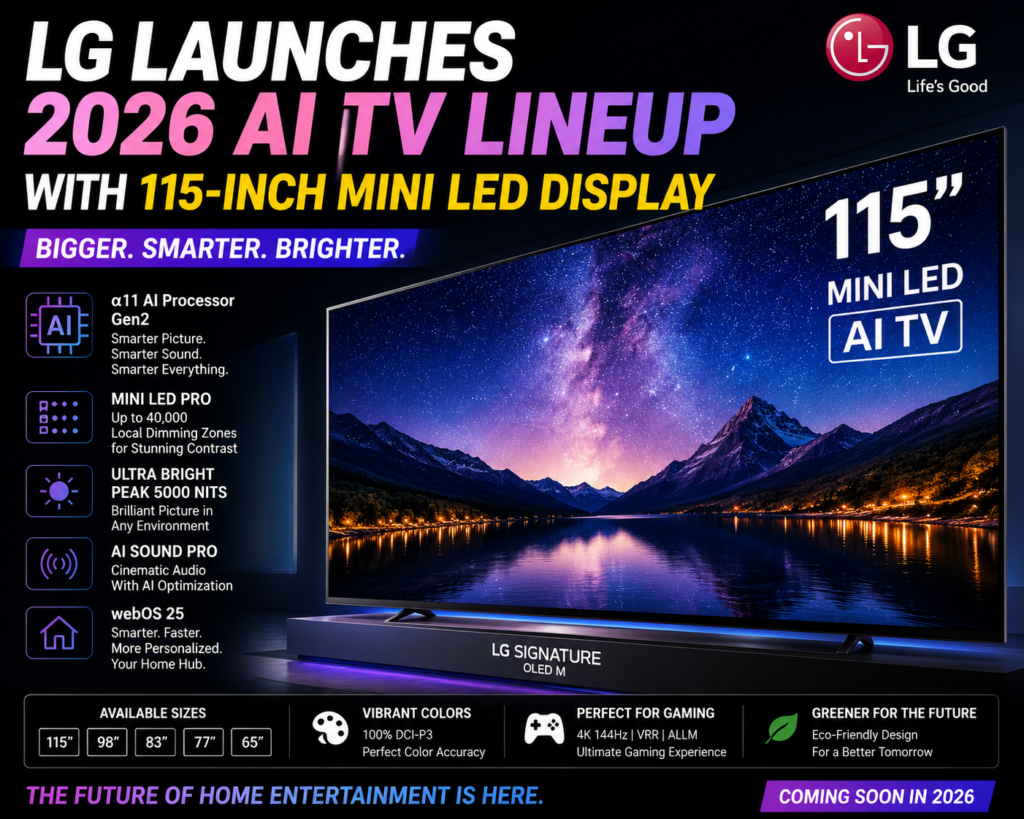
The flagship: QNED evo Mini LED, topping out at 115 inches
The star of the show is the QNED evo Mini LED series, spanning screen sizes from 43 inches all the way up to 115 inches. The flagship model is built around a few headline technologies:
- Dynamic QNED Color Pro — color mapping tuned to keep tones rich and accurate even in bright HDR scenes, certified by Intertek for 100% color volume.
- Precision Dimming Ultra — finer local dimming control, which matters more the bigger the panel gets.
- Motion Booster up to 330Hz, with select models supporting 165Hz Variable Refresh Rate and Auto Low Latency Mode — squarely aimed at gamers, not just movie watchers.
Driving all of it is LG’s Alpha 8 AI Processor Gen 3 on the higher-end variants, which LG is positioning as the engine behind sharper upscaling, smarter tone mapping, and the TV’s AI-driven features more broadly.
The AI features aren’t just marketing language
A few of the standout software features actually change how you use the TV, not just how it looks:
- Voice ID recognizes individual users by voice and automatically loads their personalized “My Page” home screen — useful for households where everyone’s watch history and app layout differs.
- AI Concierge offers context-aware suggestions based on what you’re currently doing on the TV, rather than a static, one-size-fits-all home screen.
- Multi-AI support brings both Google Gemini and Microsoft Copilot directly into the TV experience, letting users ask questions, pull up information, or search for related content without reaching for a phone.
- LG Shield, a CES 2026 Innovation Award winner, handles the security side — encrypting user data and personalized settings across the whole AI ecosystem.
It’s not just one TV — it’s a full tier system
The 115-inch model gets the headlines, but LG built out the lineup underneath it:
- QNED evo Mini LED (QNED90 down to QNED70/75/80, depending on region): the ultra-large-screen workhorse, running from 43 inches up to that 115-inch flagship.
- OLED evo family (G6, C6, B6): LG’s refreshed OLED tier for buyers who want per-pixel contrast over Mini LED’s brightness advantages.
- Nano 4K UHD: a more budget-friendly large-screen option, running 43 to 98 inches, powered by the Alpha 7 AI Processor Gen 9, with Nano Detail Enhancer, HDR10 Pro, and Dolby Atmos.
- Smart AI TV (LB65 series): the entry point, in 32- and 43-inch sizes, still carrying AI-powered personalization, Gemini and Copilot support, and five years of promised webOS updates — a notable commitment for a budget-tier product.
Pricing varies sharply by region and tier
Availability and pricing differ by market. In India, the QNED lineup starts around ₹52,990 (~$556), the Nano 4K UHD line starts at ₹38,990 (~$409), and the entry-level Smart AI TV starts at ₹19,990 (~$210) — all considerably below flagship pricing, since those figures reflect the smaller sizes in each line, not the 115-inch model. In the U.S., the flagship 115-inch QNED92 retails at $12,999.99 and has been available for pre-order directly through LG.com.
The bigger play: gaming and sports as the pitch, not just picture quality
LG isn’t just selling “bigger and sharper” — the marketing language throughout leans hard into sports and gaming specifically. The combination of high refresh rates, VRR, low input lag, and the LG Gaming Portal (LG’s built-in access point for cloud gaming services and native web games) suggests the company is chasing the living-room-as-stadium pitch: a screen large enough and fast enough to make watching a match or playing competitively feel like the main event, not a compromise.
The takeaway
LG’s 2026 lineup is less about one hero product and more about AI features trickling all the way down the price ladder — from a $13,000 115-inch flagship to a $210 entry-level set, every tier now ships with some form of AI personalization, upscaling, or assistant integration built in. Whether that’s a meaningful upgrade or just this year’s expected checkbox depends on how much you actually use Voice ID, AI Concierge, or an AI assistant on your TV versus just wanting a really big, really good-looking screen.