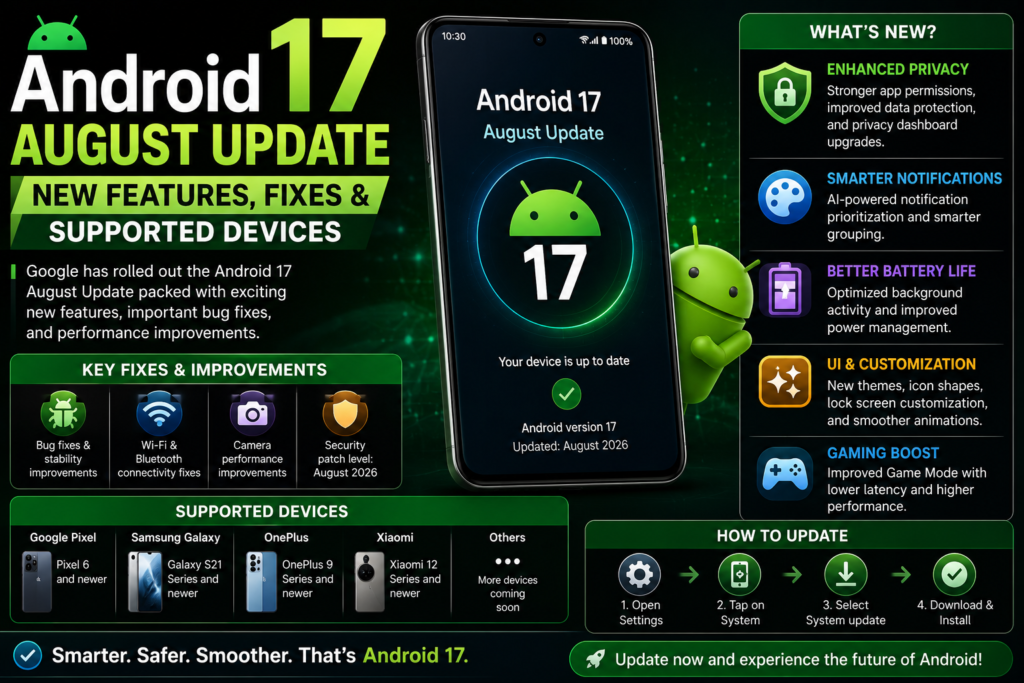
Google has kicked off the August 2026 rollout for Android 17 devices — and if you’re expecting a flashy new feature drop, this isn’t it. This month’s release is a maintenance patch: security fixes, stability improvements, and a handful of bug fixes squarely aimed at Pixel 10 owners, layered on top of the Android 17 platform that shipped back in June.
Here’s exactly what’s in it, and whether your device is even getting it.
The rollout basics
- Start date: August 4, 2026, rolling out in phases globally over roughly a week.
- Build number: CP2A.260805.005 (global); CP2A.260805.005.A1 for Rogers devices in Canada.
- Security patch level: 2026-08-05.
- How to check: Settings > System > System update > Check for update.
As always, timing depends on carrier and region — some devices will see the notification arrive before others even within the same country.
What’s actually fixed this month
This is a bug-fix and stability release, not a feature release. The confirmed fixes include:
- Touchscreen unresponsiveness on affected Pixel 10 devices — a fix for a real, reported pain point rather than a preventive patch.
- Gaming app crashes under specific conditions, resolved for titles that were previously unstable.
- GPU performance optimizations, aimed at improving graphics performance in certain scenarios — most likely to benefit Pixel 10-series gaming and graphically intensive apps.
- CVE-2026-0163, a high-severity elevation-of-privilege vulnerability in the Video Processing Unit, now patched to reduce the risk of unauthorized privilege escalation.
Google has also published its usual full list of security fixes in the Pixel Security Bulletin for anyone who wants the complete rundown beyond the headline items.
Which devices are getting it
This month’s stable rollout is going to Pixel 8, Pixel 8a, the Pixel 9 lineup, the Pixel 10 lineup, and the Pixel 10a.
Notably absent: Pixel 6, 6 Pro, 6a, 7, 7 Pro, and 7a. That’s not necessarily a one-off skip — support consistency for the Pixel 6 line has reportedly been slipping, and the phone is expected to lose update support entirely in the coming months. If you’re still on a Pixel 6-series device, this is a good moment to start planning for an eventual upgrade, even if it isn’t urgent yet.
Interestingly, Google is testing further ahead in parallel: an Android 17 QPR2 beta is currently rolling out to Android Beta Program participants on devices as old as the Pixel 6a — so even as the 6-series ages out of stable updates, it’s still getting some beta-channel attention for now.
Zooming out: what Android 17 itself actually changed
Since this month’s patch builds on the broader Android 17 platform, it’s worth remembering what that release actually brought when it launched in June. Google described Android 17 as the start of a shift toward “an intelligence system, putting your apps at the center” — the headline changes included:
- Mandatory large-screen resizability for apps, part of Google’s adaptive-first push for tablets and foldables.
- Foldable gaming improvements, including a dedicated 50/50 layout with gameplay on the top half of the screen and gamepad-style controls on the bottom.
- Session-based permissions, letting apps request one-time precise location access or temporary contact access instead of requiring broad, persistent permissions.
- Upgraded “Mark as Lost” in Find Hub, which now locks a lost device behind biometric authentication — meaning even someone who knows your PIN can’t get in without your fingerprint or face.
- Improved Live Threat Detection, aimed at identifying and blocking suspicious app behavior more effectively.
What about non-Pixel phones?
Android 17 is spreading to the rest of the Android ecosystem on its usual staggered timeline. Samsung’s Galaxy Z Fold 8 and Z Flip 8 are among the earliest non-Pixel devices to pick it up, alongside early Motorola and OnePlus rollouts. The Galaxy S26 series, more OnePlus models, and Xiaomi, OPPO, Vivo, and Honor flagships are expected to follow in the September–October window, with broader mid-range and budget devices trailing into early 2027 — the usual pattern for how long it takes a new Android version to actually reach the majority of phones in use.
One detail worth flagging for anyone chasing the newest AI features specifically: while every Android 17 device gets the core platform, features, and security improvements, Gemini Intelligence on top of Android 17 requires Gemini Nano v3 hardware and 12GB of RAM — currently limited to devices like the Pixel 10 series and Galaxy S26 series. Having Android 17 installed doesn’t automatically mean you get every AI feature Google is marketing alongside it.
The takeaway
If you own a Pixel 8 or newer, this update is worth installing promptly — it fixes a real, high-severity security vulnerability along with the kind of everyday annoyances (unresponsive touchscreen, gaming crashes) that are worth resolving even without a headline feature to go with them. If you’re on a Pixel 6-series device, take the update while it’s still coming, and keep an eye on official support timelines, since that line appears to be nearing the end of its update runway.