For two years, Apple’s answer to the AI arms race has been conspicuously restrained. While OpenAI, Google, and Meta poured hundreds of billions into data centers and model training, Apple sat on more than $130 billion in cash and shipped an Apple Intelligence rollout that, by most accounts, underdelivered. The iPhone 18 lineup is where that restraint either becomes vindicated or becomes a real problem — and the strategy Apple has revealed so far suggests it knows exactly which outcome it’s betting on.
The headline move: Siri gets rebuilt, and gets outside help
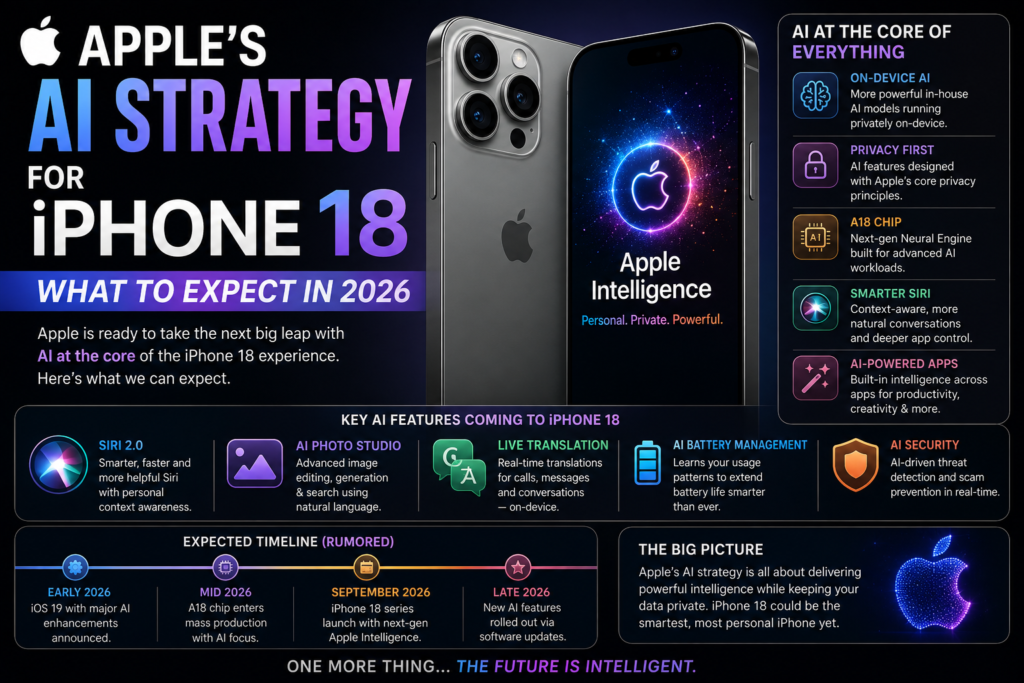
The centerpiece of Apple’s 2026 AI push isn’t a new chip or a camera sensor — it’s Siri. Announced at WWDC in June, the rebuilt assistant (internally and publicly referred to as “Siri AI”) represents a genuine shift from voice assistant to something closer to an AI agent: it now incorporates personal context, on-screen awareness, and the ability to take actions across apps, not just answer questions. It’s rolling into iOS 26 as a developer beta now, with a full public release expected in the fall alongside the iPhone 18 launch, and it’s extending across iPhone, iPad, Mac, Apple Watch, and Vision Pro.
The more surprising part is how it’s powered. Apple is reportedly turning to Google’s Gemini as the foundation model underneath the new Siri — a tacit admission that building a frontier LLM in-house wasn’t worth the capital expenditure Apple was unwilling to spend. It’s a pragmatic bet: large language models may be commoditizing, so why not license the best one and spend Apple’s differentiation budget on integration, privacy, and hardware instead.
Developers get a bigger opening too
Alongside the new Siri, Apple significantly expanded its Foundation Models Framework, opening it up to support not just Apple’s own models but a wider range of outside AI services — and adding multimodal support so developers can feed photos, screenshots, and documents directly into AI models within their own apps. It’s Apple positioning itself as the platform AI runs on, rather than insisting every AI feature has to be Apple’s own model.
The hardware side: an A20 chip built for AI, not benchmarks
The iPhone 18 Pro and Pro Max are expected to ship with the A20 chip, Apple’s first built on TSMC’s 2nm process — reportedly up to 15% faster and 30% more power-efficient than the current A19. That efficiency gain matters more for AI workloads than headline benchmark numbers: on-device generative features are power-hungry, and Apple has consistently prioritized on-device processing for privacy reasons rather than routing everything to the cloud.
RAM is the more telling spec bump. The Pro models are expected to jump to 9GB, with some reports suggesting Apple could standardize at 12GB across the lineup — more memory being exactly what’s needed to run larger AI models locally rather than depending on a server round-trip.
A split launch, and a two-tier AI experience
Apple is reportedly breaking from its usual single-autumn-launch pattern this year. The iPhone 18 Pro, iPhone 18 Pro Max, and Apple’s first foldable iPhone — a book-style design with a roughly 5.5-inch outer display and 7.8-inch inner display — are expected in September 2026. The standard iPhone 18 and a new iPhone 18e are being pushed to spring 2027.
That split has a direct AI consequence: reports suggest the full suite of Apple Intelligence and Siri AI features will require 12GB of RAM, which the Pro models get first. That would make the iPhone 18 Pro the exclusive gateway to Apple’s most advanced AI features this year, while anyone holding onto an iPhone 17 — or waiting for the cheaper iPhone 18 next spring — gets a lesser AI experience in the meantime.
Leadership shake-up behind the scenes
The AI overhaul comes with real organizational change. Siri has been placed under Mike Rockwell, the executive who led the Vision Pro’s launch — a signal Apple wants product-shipping discipline applied to an assistant that’s been plagued by delays. Meanwhile, Apple’s AI chief John Giannandrea announced his retirement, with parts of his organization redistributed into more product-focused teams. Read together, it looks like Apple concluded its AI problem wasn’t a talent or research gap — it was an execution and organizational one.
Why Apple’s caution might actually pay off
The bull case for Apple’s restraint rests on a specific bet: that the AI capital expenditure race between OpenAI, Google, and Meta is running into real skepticism about whether hundreds of billions in near-term spending can be justified by revenue, and that a “bubble” correction could hit hardest for companies most exposed to it. Apple, by comparison, enters 2026 with enormous cash reserves and none of that overhang — able to distribute AI features directly through software updates and system-level integration across a massive installed base, rather than needing a standalone app or subscription to succeed.
The bottom line
Apple’s iPhone 18 AI strategy isn’t about winning a benchmark war — it’s about finally shipping an assistant that works, powered by outside AI where it makes sense, backed by hardware built for on-device processing, and rolled out to premium buyers first while the company plays catch-up on the assistant that arguably should have shipped years earlier. Whether “restrained but late” beats “aggressive but overextended” is the real experiment 2026 is going to settle — for Apple, and arguably for the entire AI industry’s spending habits.