
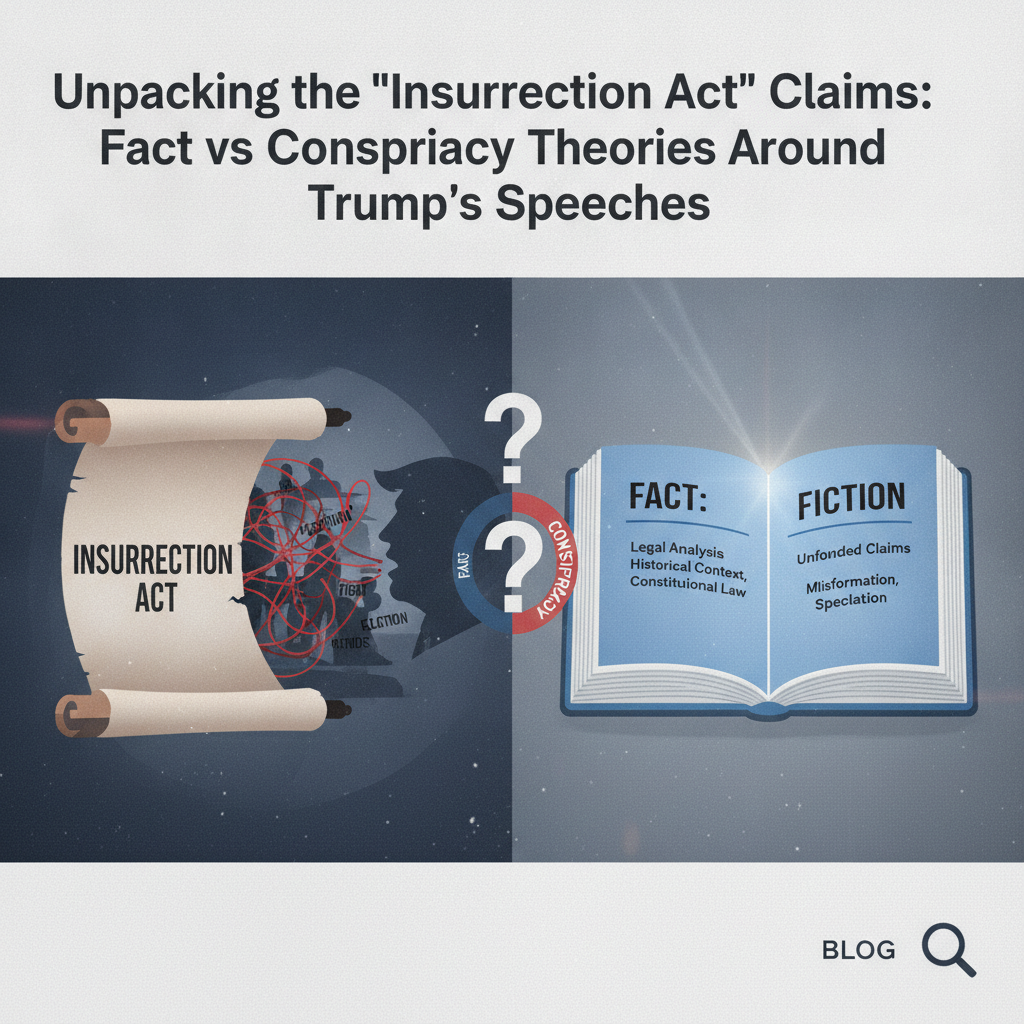
In the politically charged landscape of today, certain phrases and legal concepts often become focal points for intense debate and speculation. Among these, the ‘Insurrection Act’ has repeatedly surfaced in various online communities, particularly in connection with interpretations of former President Donald Trump’s speeches. This convergence has fueled a specific brand of conspiracy theory, suggesting that Trump’s rhetoric is a deliberate prelude to invoking this powerful, rarely used federal law. But what exactly is the Insurrection Act, what are these theories, and how do they stack up against legal realities?
This post aims to dissect these claims, provide a clear understanding of the Insurrection Act, and distinguish between speculative narratives and established legal frameworks.
The Conspiracy Theory in Focus: Trump’s Speeches and the Insurrection Act
The core of this particular conspiracy theory posits that specific statements or underlying themes within Donald Trump’s public addresses are not merely political rhetoric, but coded messages or strategic steps towards activating the Insurrection Act. Adherents often interpret calls for ‘justice,’ ‘retribution,’ or references to election integrity as signals for an impending, dramatic intervention that would grant Trump extraordinary powers, potentially through military deployment within the U.S. to ‘restore order’ or overturn perceived injustices.
These theories often intertwine with broader narratives of a ‘deep state,’ a rigged system, or an impending ‘storm’ that will expose widespread corruption and result in a dramatic restructuring of power. The Insurrection Act, in this context, becomes the perceived legal mechanism through which such a sweeping change would be enacted.
Understanding the Insurrection Act: A Legal Overview
To properly evaluate these claims, it’s crucial to understand what the Insurrection Act actually is and how it functions. Enacted in 1792 and subsequently amended, the Insurrection Act (primarily codified in 10 U.S.C. §§ 251-255) is a set of federal laws that empower the President of the United States to deploy U.S. military personnel within the country to suppress civil disorder, rebellion, or insurrection.
Key Provisions and Conditions for Invocation:
- State Request: Typically, the Act requires a request from a state’s governor or legislature for federal assistance in situations where state authorities are unable to suppress an insurrection or domestic violence.
- Federal Intervention: The President can also act without a state’s request in certain circumstances, such as when federal law or constitutional rights are being violated to an extent that obstructs the execution of federal laws or impairs the functioning of federal institutions.
- Purpose: Its primary purpose is to aid civil authorities in restoring law and order, not to overthrow the existing legal framework or to install an alternative government.
- Historical Usage: While rarely used, it has been invoked in various historical instances, primarily to enforce civil rights legislation during the Civil Rights Movement or to quell labor unrest. Its invocation is a significant event, signaling a severe breakdown of civil authority.
Crucially, the Act is subject to significant legal and constitutional constraints and is generally viewed as a measure of last resort. It does not grant the President unlimited power and is designed to uphold the Constitution, not to subvert it.
Analyzing Trump’s Rhetoric and the Reality of Invocation
When comparing the specific claims of conspiracy theorists with the legal reality of the Insurrection Act, several key distinctions emerge:
- Interpretation vs. Legal Trigger: Trump’s speeches, while often provocative and subject to wide interpretation, do not inherently meet the stringent legal criteria required to invoke the Insurrection Act. The Act requires demonstrable civil unrest, rebellion, or obstruction of federal law that state authorities are unable to control. Rhetoric, no matter how strong, does not constitute these conditions.
- Lack of Official Action: Despite the persistent theories, there has been no official declaration, executive order, or discernible governmental action by Trump (during his presidency or after) that legally initiated the Insurrection Act for the purposes claimed by these theories. Legal processes require clear, public, and documented steps.
- Checks and Balances: Invoking the Insurrection Act is a serious decision with significant political and legal ramifications, subject to public scrutiny and potential legal challenge. It is not a secret weapon that can be deployed under the radar.
- Misunderstanding of Authority: Many theories fundamentally misunderstand the scope and limitations of presidential power, particularly concerning the military and its role in domestic affairs. The military’s primary duty is to protect the Constitution, not to serve as a personal instrument of political change outside of established legal channels.
The Danger of Disinformation and Misinterpretation
The spread of conspiracy theories linking political speeches to complex legal mechanisms like the Insurrection Act highlights a broader challenge: the proliferation of disinformation and the misinterpretation of facts. Such narratives can:
- Erode Trust: By promoting false understandings of government and law, they can undermine public trust in institutions and the democratic process.
- Polarize Society: They often contribute to extreme political polarization, creating an ‘us vs. them’ mentality based on false pretenses.
- Distract from Real Issues: Focusing on unfounded conspiracies can divert attention from legitimate political discourse and policy debates.
- Incite Harm: In extreme cases, misinterpretations can lead to real-world actions, threats, or violence based on false beliefs.
Conclusion: Critical Thinking in a Complex World
While curiosity about legal frameworks and political maneuvers is natural, it’s essential to approach information with a critical eye, especially in the digital age. The idea that Donald Trump’s speeches secretly pave the path to invoking the Insurrection Act remains firmly in the realm of conspiracy theory, lacking substantive legal or factual basis.
Understanding the actual provisions and limitations of laws like the Insurrection Act, and separating them from speculative interpretations, is vital for informed citizenship. In an era saturated with information, discerning between credible legal analysis and unfounded claims is more important than ever to maintain a clear perspective on political realities.