After a decade on Android phones, Google Assistant has an actual expiration date. Starting September 4, 2026, Google will begin removing Assistant from phones, tablets, Wear OS smartwatches, headphones, and Android Auto — replacing it entirely with Gemini. Once the switch reaches your device, there’s no going back: you won’t be able to reinstall or switch back to Assistant.
Here’s what’s actually changing, what stays the same, and what to do before it happens to you.
The rollout, in plain terms
Google confirmed the change in an email sent to users, first surfaced by 9to5Google. The exact wording: “Google Assistant on your mobile device is being discontinued, and Gemini — our next-generation AI-powered assistant — is now the Assistant experience on Android.” The removal begins September 4 and rolls out gradually — Google says the process “may take a few weeks to reach everyone,” so not every device flips over on day one.
This isn’t a sudden pivot. Google first announced the plan to move users from Assistant to Gemini back in March 2025, and the original target was to complete the migration by the end of 2025. That deadline slipped by nearly a year — most likely so Gemini had time to actually match what Assistant could already do reliably.
What stays exactly the same
A few things Google is explicitly preserving, which matters if your daily routine leans on them:
- “Hey Google” voice activation keeps working, unchanged.
- Physical assistant buttons on supported devices remain functional.
- Google-built-in cars keep Google Assistant, at least for now — this change doesn’t touch vehicles.
- Google Home, Google TV, and smart speakers/displays aren’t part of this particular wave. Google has said a Gemini-powered experience is coming to those devices too, but it’s being handled separately.
What actually changes
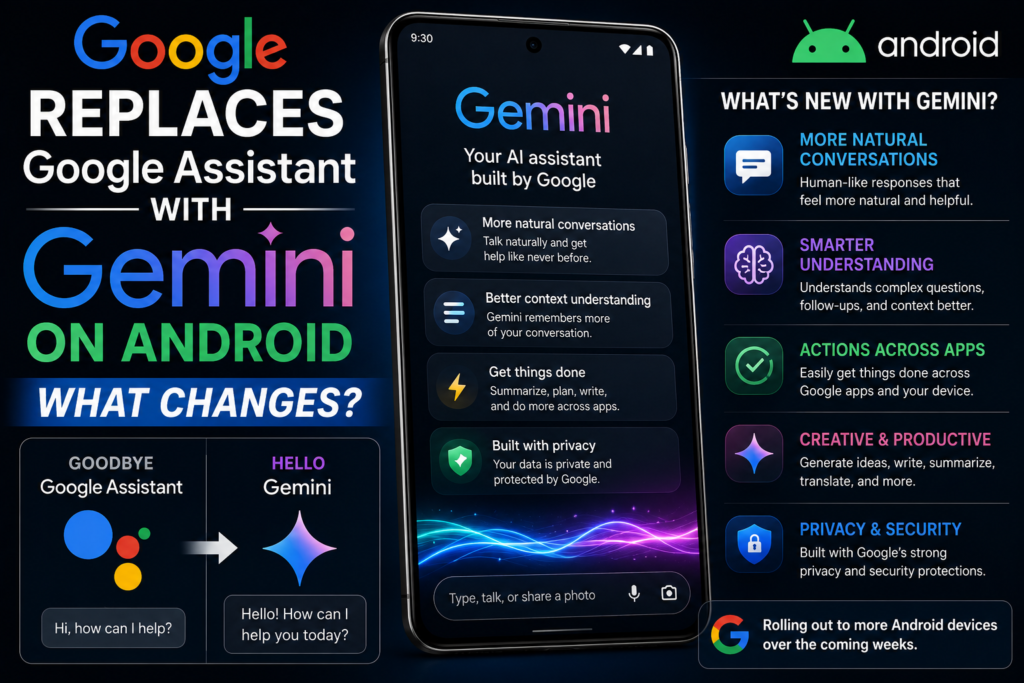
The core shift is architectural, not cosmetic. As one Google product expert described it internally, this is a move “from the deterministic, micro-task architecture of Google Assistant to the conversational, multimodal capabilities of Google Gemini” — in plainer terms, from a system built around fixed, narrow commands to one built around open-ended conversation and reasoning.
In practice, that means:
- Multi-turn conversations. Instead of one command, one response, Gemini can hold context across a back-and-forth exchange.
- Complex, multi-step task handling. Google has introduced Gemini Spark, an agentic model that — with permission — can use your logged-in accounts and saved passwords to complete tasks like booking appointments or filling out forms, rather than just looking things up.
- Deeper integration across Google’s ecosystem. Gemini pulls into Gmail, Docs, Calendar, Maps, and YouTube more natively than Assistant ever did.
- Wear OS and Android Auto are both getting expanded conversational Gemini integration as part of the same wave.
The catch: some Assistant basics are still catching up
Not everyone is convinced the trade is even yet. Some user complaints circulating around the announcement point to surprisingly basic friction — for instance, reliably playing a specific song from an arbitrary media player, something Assistant has handled for over a decade, reportedly still trips up Gemini in some cases. Google has been adding back specific, highly requested Assistant features into Gemini ahead of the cutover — music playback controls, timers, and the ability to take actions directly from the lock screen — precisely because these fundamentals weren’t there when Gemini first launched as an option.
That’s worth keeping in mind if you’ve stuck with classic Assistant this long specifically because it “just works” for simple daily tasks. The migration assumes Gemini has closed that gap; whether it actually has, for your specific habits, is worth testing before your device switches over on its own.
Who’s exempt, at least for now
Google has said devices that don’t meet Gemini’s minimum specifications — older phones running early Android versions or devices with limited memory — will continue running classic Assistant “at this time.” That’s a soft exemption, not a permanent one; it reads as a hardware limitation Google hasn’t fully solved yet, not a long-term commitment to keep Assistant alive anywhere.
Why now
This lines up with where Google’s hardware strategy has already been heading — Gemini has been the default assistant on Pixel phones since the Pixel 9 launched. The Android-wide cutover is really Google finishing a transition it started with its own flagship hardware and extending it to the entire platform. It also follows a broader pattern: Google has spent the last year quietly stripping pieces of Assistant’s functionality out and replacing them with Gemini equivalents, rather than flipping the switch all at once.
The bottom line
If you’re an Android user who’s never touched the Gemini toggle, September 4 is when that stops being optional. The good news is Google has clearly used the extra year to backfill basic functionality Gemini was missing. The real question is whether “conversational and multimodal” is actually a better daily-use assistant than the older, narrower one it’s replacing — or whether, like a lot of AI-for-AI’s-sake product decisions, it trades reliability for capability you didn’t ask for.