The tech job market in 2026 isn’t one market — it’s two, running in opposite directions at the same time. One is contracting. The other is on fire. And increasingly, which one you’re in matters more than whether you work in “tech” at all.
Here’s what the actual hiring data shows.
The headline split: general tech is down, AI roles are surging
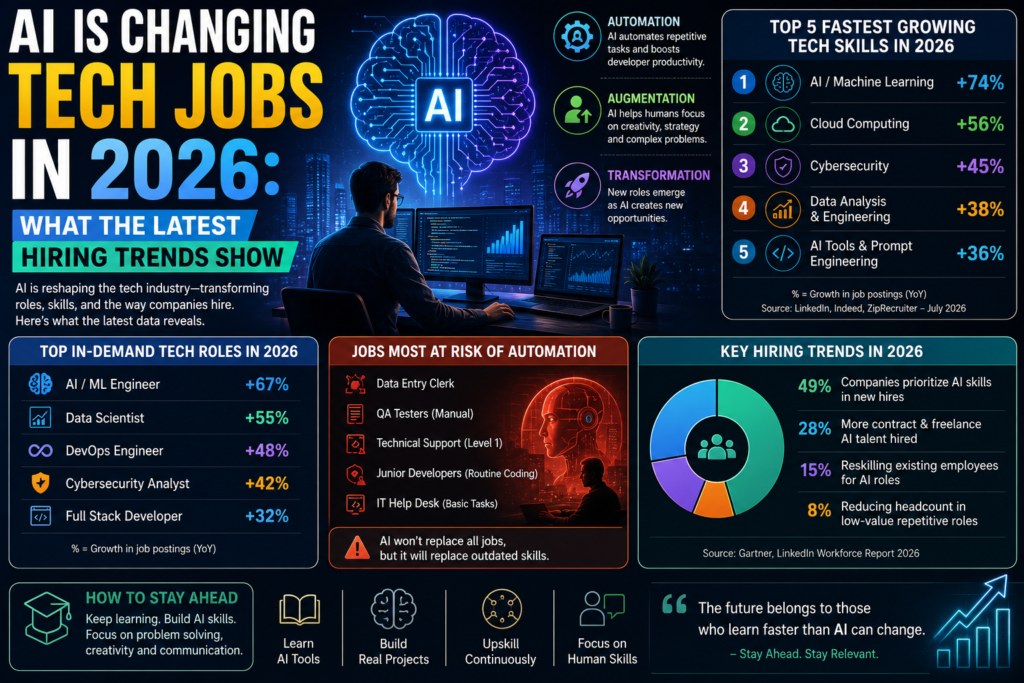
US tech job listings overall sit roughly 36% below their February 2020 baseline. General software engineering postings specifically are down 49% over that same window. Meanwhile, machine learning engineer openings are up 59% over the identical period. Anyone reading a single “tech is hiring” or “tech is dead” headline is missing the split that actually explains the market: recruiters are now sourcing from two fundamentally different talent pools — a contracting, oversupplied market for general developers, and a hot, scarce, expensive market for AI and ML specialists.
The growth numbers on the AI side are genuinely extreme. AI, ML, and data science job postings hit 49,200 in 2025, up 163% from the year before. By January 2026, CompTIA counted more than 275,000 active job postings referencing AI skills specifically.
AI fluency is no longer a specialist requirement — it’s baseline
Perhaps the most telling number in the entire 2026 data set: 79% of all US tech job postings now list AI skill requirements, up from 75% just the month before, and up 144% year-over-year from July 2025. That’s not a niche category anymore — AI fluency has become table stakes across most of tech hiring, not a differentiator reserved for specialized roles.
The pay gap is real and it’s widening
Robert Half’s 2026 Salary Guide pegs the national software engineer salary range at $109,250 to $175,500, versus $134,000 to $193,250 for AI/ML engineering roles — roughly a $25,000 floor premium for AI specialization. At staff level specifically, AI engineers earn about 18.7% more than their non-AI peers. The message to anyone weighing where to specialize is blunt: the premium isn’t marginal, and it gets larger the more senior you get.
Employers are hiring and cutting at the same time
Here’s the tension defining 2026 hiring plans: 66% of employers say they plan to hire talent with specific AI skills, while 40% simultaneously expect to reduce headcount in areas where AI agents can automate existing tasks. Those aren’t contradictory statements from different companies — in many cases, it’s the same organizations doing both at once, growing their AI capability while shrinking the roles AI is increasingly able to handle.
Indeed’s 2026 Jobs and Hiring Trends Report describes the broader labor market as being in “pause mode” — demand has softened, but layoffs remain generally low and workers are staying put. Labor economists have taken to calling this equilibrium “low hire, low fire.” It creates a strange dynamic where the market feels tight from both directions: employers say they can’t find qualified candidates, while job seekers say they can’t land interviews.
Why the application funnel itself is breaking
Part of that paradox has a specific, AI-driven cause. AI-assisted applications are flooding hiring pipelines — when anyone can generate a polished, tailored cover letter and resume in seconds, the volume of applications explodes while the traditional screening process breaks down trying to find genuine signal in the noise. The response has been notable: 70% of technology leaders say the flood of AI-generated applications alone has made them more likely to turn to staffing or consulting firms specifically to help manage volume and identify real AI-skill gaps in candidates. Among leaders who’ve done this, 93% say it’s actually worked.
What this means if you’re early in your career
The situation is particularly sharp for recent graduates. Entry-level tech roles in 2026 increasingly expect AI fluency from day one, carry broader cross-functional expectations, and demand a faster ramp to productivity than in past years. The graduates actually landing offers tend to be the ones who can demonstrate value beyond what an AI tool already provides on its own — through complex problem-solving, system design thinking, or domain expertise that AI genuinely can’t replicate yet.
Not every company is following the general contraction trend, either. IBM announced plans to triple its entry-level US hiring in 2026, explicitly running counter to the broader pattern — reasoning that building AI-augmented junior talent now is cheaper than competing for scarce senior AI expertise later. It’s a bet worth watching: if it pays off, it could become a model other large employers follow rather than an outlier.
Where the growth is concentrated
A few sector and role-level trends stand out in the second half of 2026:
- Cybersecurity and cloud infrastructure remain both a constraint and an opportunity — tight security talent pools combined with the shift to cloud-driven infrastructure are forcing companies to compete harder for specialized engineers.
- Insurance posted the largest month-over-month tech hiring gain of any industry in July, up 66%, as carriers build out model infrastructure, data pipelines, and agentic automation — a reminder that AI hiring demand isn’t confined to traditional tech companies anymore.
- Technology leaders overall are hiring aggressively in the second half of 2026: 78% plan to increase permanent headcount, up sharply from 61% earlier in the year, alongside 66% planning to bring in more contract talent.
The bottom line
If you work in tech, the honest read on 2026 isn’t “AI is taking jobs” or “AI is creating jobs” — it’s both, sorted by specificity and adaptability. Broad, generalist software roles are shrinking. AI-adjacent skill, cybersecurity depth, and the ability to do what AI genuinely can’t yet are commanding real premiums and real hiring appetite. The safest position in this market isn’t avoiding AI — it’s being the person who can build, secure, and fix the systems AI increasingly runs on top of.