
A New Era for Space Intelligence
For decades, satellites have acted primarily as data collectors, capturing images and sending vast amounts of information back to Earth for analysis. But a major technological breakthrough is changing that model.
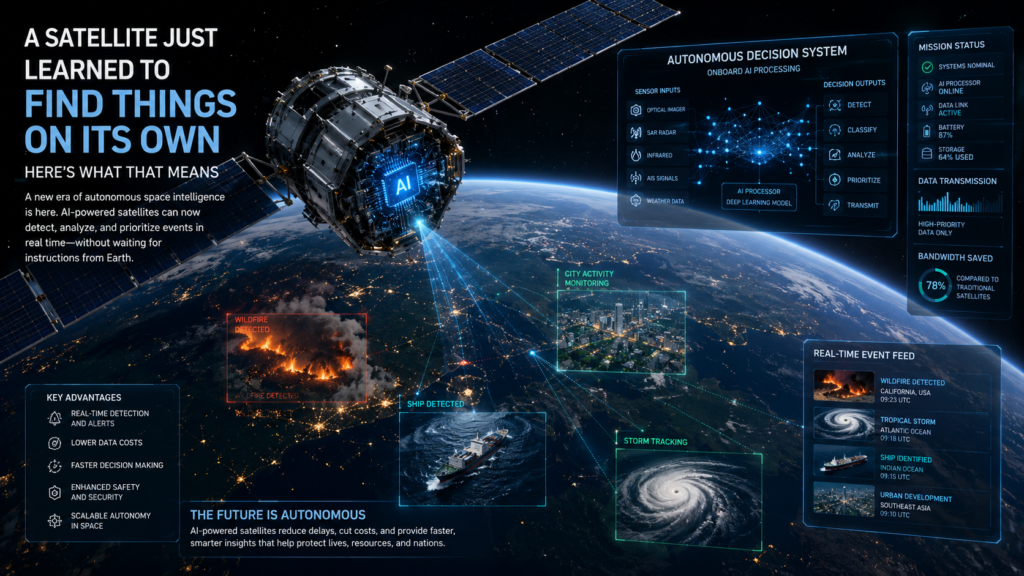
A new generation of AI-powered satellites can now identify, analyze, and prioritize objects directly in orbit, without waiting for instructions from ground stations. In simple terms, satellites are beginning to “think” for themselves.
This advancement could transform everything from national security and disaster response to environmental monitoring and commercial space operations.
How Traditional Satellites Work
Most satellites follow a simple process:
- Capture images or sensor data.
- Transmit the data to Earth.
- Ground-based computers analyze the information.
- Human operators decide what matters.
This approach works, but it can be slow and expensive. Massive amounts of data must be transmitted, even when only a small portion is useful.
What Makes AI Satellites Different?
AI-enabled satellites can process information onboard using advanced machine learning systems.
Instead of sending everything back to Earth, the satellite can:
- Detect ships at sea
- Identify wildfires
- Track storms
- Monitor military activity
- Spot infrastructure changes
- Detect environmental events
The satellite can then prioritize important information and send only the most relevant data.
This dramatically reduces communication delays and bandwidth requirements.
Why This Is a Big Deal
Faster Disaster Response
When wildfires, floods, or hurricanes occur, every minute matters.
An intelligent satellite could automatically detect a developing disaster and immediately alert emergency responders.
Better National Security
Military and intelligence agencies could receive real-time updates on critical activities without waiting for analysts to review every image.
Lower Data Costs
Processing data in orbit reduces the amount of information that must be transmitted back to Earth, saving bandwidth and operational costs.
More Autonomous Space Systems
Future satellites may coordinate with one another, sharing information and making decisions collectively.
The Technology Behind It
These smart satellites combine several cutting-edge technologies:
- Artificial Intelligence
- Machine Learning
- Edge Computing
- Advanced Sensors
- High-performance Space Processors
- Autonomous Decision Systems
Together, these technologies allow satellites to analyze data directly where it is collected.
Challenges and Risks
While the technology is promising, experts are also raising important questions:
Accuracy
What happens if the AI misidentifies an object?
Accountability
Who is responsible if an autonomous system makes a mistake?
Security
Could hackers manipulate satellite AI systems?
Ethical Concerns
How much decision-making authority should machines have in space?
As satellite intelligence advances, governments and regulators will likely develop new frameworks to address these concerns.
The Future of Autonomous Satellites
Experts believe this is just the beginning.
Future AI satellites may:
- Coordinate in swarms
- Track global events in real time
- Automatically task other satellites
- Monitor climate change continuously
- Support lunar and Mars missions
- Enable autonomous space exploration
Instead of acting as passive cameras in orbit, satellites could become active participants in gathering and interpreting information.
Conclusion
The ability for satellites to identify and prioritize important information on their own marks a significant step forward in space technology. By combining artificial intelligence with orbital observation systems, satellites are becoming faster, smarter, and more autonomous than ever before.
As AI continues expanding beyond Earth and into space, the way humanity observes and understands our planet could change dramatically.
Leave a Reply