
While generative AI grabs headlines with flashy chatbots and image generators, another revolution is quietly taking place behind the scenes: training robots to understand and interact with the physical world.
Unlike language models, robots can’t simply learn from billions of web pages. They need something far more difficult to obtain—real-world experience. And gathering that experience is proving to be messy, repetitive, and incredibly labor-intensive.
That’s where companies like XDOF are stepping in.
Why Robot Training Data Is So Hard to Collect
Large language models learn from text and images found online. Robots, however, need to learn how to:
- Pick up objects.
- Open doors.
- Fold clothes.
- Stack boxes.
- Navigate rooms.
- Handle unexpected situations.
Every movement requires thousands—or even millions—of examples.
A robot must understand:
- Position
- Force
- Speed
- Object shape
- Motion dynamics
- Human interactions
This data doesn’t exist naturally on the internet. Someone has to create it.
The Dirty Reality Behind Robotics
Collecting robot data isn’t glamorous.
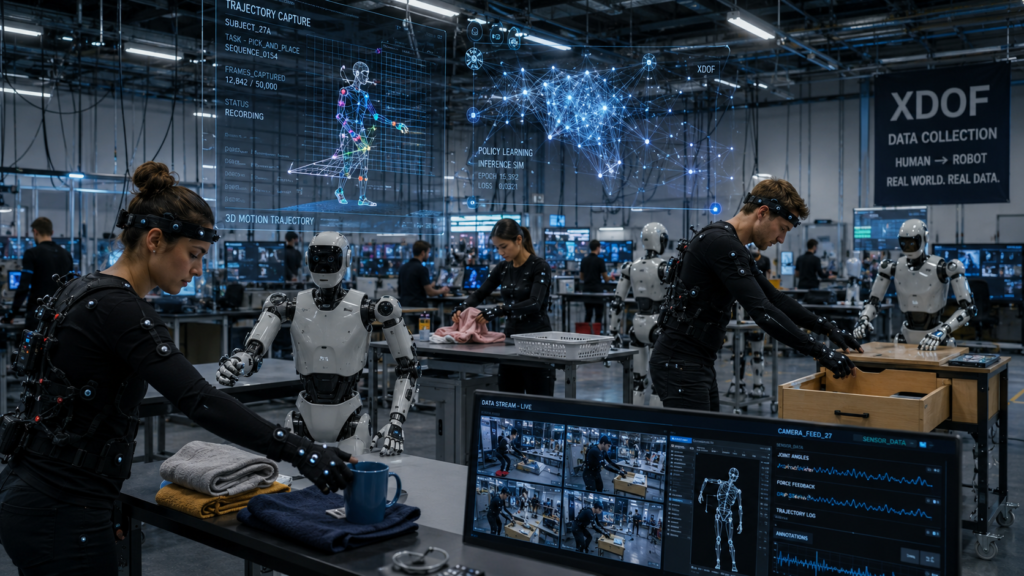
Workers often spend hours performing repetitive tasks while wearing sensors or controlling robotic arms. They may:
- Pick up cups hundreds of times.
- Open and close drawers repeatedly.
- Arrange objects in countless combinations.
- Demonstrate household chores.
- Label videos and movement patterns.
What looks simple to humans can be incredibly difficult for machines.
For example, grasping a slippery bottle from a cluttered shelf involves complex calculations involving vision, force, and motion.
Why AI Labs Are Turning to XDOF
As demand for robotics explodes, AI companies are outsourcing data collection to specialized firms like XDOF.
These companies provide:
Massive Data Pipelines
Thousands of demonstrations help robots learn physical skills faster.
Human Operators
People perform tasks that robots observe and imitate.
Motion Capture Systems
Sensors record precise hand and body movements.
High-Quality Labels
Every action is carefully tagged and categorized.
Scalable Infrastructure
AI labs can focus on building models instead of spending years collecting data themselves.
Why Synthetic Data Isn’t Enough
Simulation environments are useful, but they can’t perfectly recreate reality.
Real-world environments contain:
- Unexpected obstacles.
- Different lighting conditions.
- Slippery surfaces.
- Deformable objects.
- Human unpredictability.
A robot trained only in simulations may fail when faced with everyday situations.
That’s why physical data remains incredibly valuable.
Humanoid Robots Need Even More Data
Companies developing humanoid robots face an even greater challenge.
Humanoid systems need to learn:
- Walking.
- Balancing.
- Using tools.
- Manipulating objects.
- Understanding spaces designed for humans.
Training such systems requires enormous amounts of motion and interaction data.
This has created a growing market for specialized robotics data companies.
The Hidden Workforce Powering AI
Behind every impressive robot demonstration is a huge amount of invisible work.
Thousands of hours of:
- Recording movements.
- Cleaning datasets.
- Labeling videos.
- Testing tasks.
- Repeating actions endlessly.
These workers rarely appear in flashy product announcements, yet they form the backbone of modern robotics.
The Future of Robot Learning
Researchers are exploring new approaches, including:
Self-Learning Robots
Robots that improve through trial and error.
Shared Learning Networks
One robot’s experiences could benefit millions of others.
Synthetic + Real Data
Combining simulations with physical demonstrations.
Foundation Models for Robotics
Similar to GPT models, these systems aim to generalize across many tasks.
Final Thoughts
The future of robotics won’t be built solely by advanced AI algorithms. It will also depend on the enormous amount of human effort required to teach machines how the real world works.
Companies like XDOF are becoming essential players in this ecosystem, providing the data pipelines that make intelligent robots possible.
The work may be dirty and unglamorous, but without it, the dream of capable household robots and autonomous assistants would remain far out of reach.
Leave a Reply