The dawn of the AI era has brought with it unparalleled innovation and efficiency, reshaping industries at a dizzying pace. As 2026 unfolds, the profound impact of artificial intelligence on the workforce is becoming increasingly clear. While AI promises to unlock new frontiers and create novel job categories, it also inevitably automates and streamlines existing roles, leading to significant workforce restructuring across the tech sector.
This page serves as a critical, real-time tracker for major tech layoffs occurring throughout 2026, specifically highlighting instances where employers have explicitly cited AI integration, automation, or AI-driven efficiency as a direct reason for job reductions. We aim to provide an objective, continually updated record of this transformative period, offering insights into which sectors, roles, and companies are most affected by the AI revolution.
Understanding the AI-Driven Workforce Shift
Before diving into specific instances, it’s crucial to understand the broader context. Companies are investing heavily in AI technologies, from advanced large language models to sophisticated automation platforms. This investment is often driven by a desire for:
- Enhanced Efficiency: AI can perform repetitive, data-intensive tasks faster and with greater accuracy than humans.
- Cost Reduction: Automating processes through AI can significantly lower operational expenses, including salaries.
- Competitive Advantage: Early adoption of AI can give companies an edge in innovation, product development, and market responsiveness.
- Strategic Restructuring: Companies are re-evaluating their organizational structures, shifting away from roles easily automated and towards roles that manage, develop, or leverage AI.
While some layoffs are a direct result of AI replacing human tasks, others might be attributed to a broader strategic shift towards an ‘AI-first’ operating model, where the entire workflow is redesigned around AI capabilities, rendering certain traditional roles redundant.
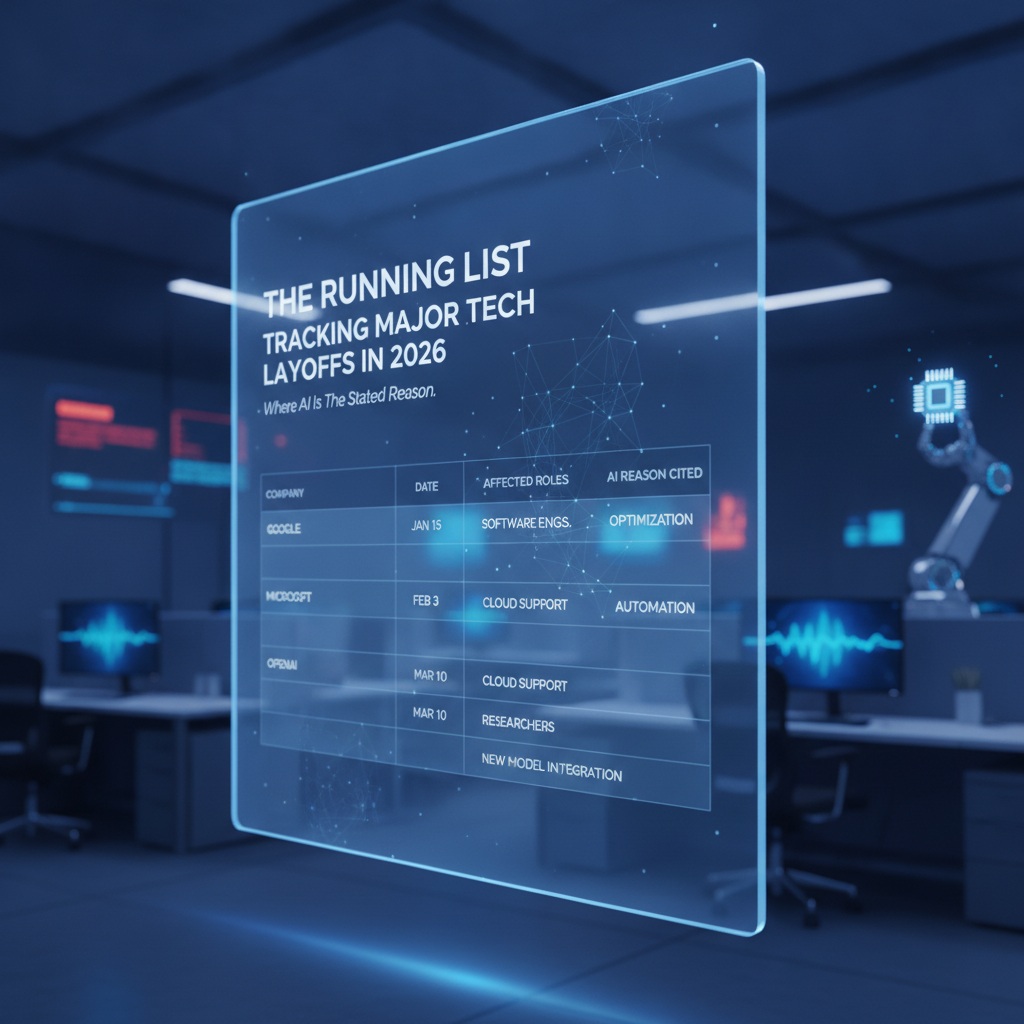
The Running List: Major Tech Layoffs in 2026 Citing AI
As 2026 progresses, this section will be updated with detailed reports of tech companies announcing layoffs and explicitly attributing these decisions, in part or whole, to AI-related factors. Each entry will include:
- Company Name: The organization announcing job cuts.
- Date Announced: The date the layoffs were publicly disclosed.
- Number of Layoffs: The approximate number of employees affected.
- Stated AI Reason: Direct quotes or paraphrased explanations from company leadership regarding AI’s role in the decision.
- Affected Departments/Roles: Insights into which parts of the organization or types of jobs were most impacted.
- Context/Analysis: Additional information regarding the company’s AI strategy, market conditions, or industry trends relevant to the layoffs.
(Please note: As of now, 2026 is in the future. This section will populate with specific company announcements as they occur throughout the year. Below are illustrative examples of the type of information and format you can expect.)
Early 2026 Observations (Illustrative Examples – *To be updated with real data*):
-
Tech Giant X (January 2026):
- Number of Layoffs: ~1,500 employees
- Stated AI Reason: CEO noted, "Our aggressive investment in proprietary AI solutions for content generation and basic coding support has significantly increased our output efficiency, leading to a reduced need for human intervention in several creative and engineering roles."
- Affected Departments/Roles: Primarily junior content writers, entry-level software developers focused on routine code maintenance, and data entry specialists.
- Context: Company X had heavily promoted its new ‘Spark AI’ platform throughout late 2025, promising revolutionary productivity gains.
-
FinTech Innovator Y (March 2026):
- Number of Layoffs: ~300 employees
- Stated AI Reason: Public statement cited, "the successful deployment of our AI-powered customer service and fraud detection systems, which have now absorbed the majority of tasks previously handled by our human operations teams."
- Affected Departments/Roles: Customer support representatives, basic fraud analysis agents, and back-office administrative staff.
- Context: FinTech Y had been a pioneer in integrating machine learning into its core banking operations for several years.
Roles and Sectors Most Susceptible to AI-Driven Displacement
While no job is entirely immune, certain roles and sectors within tech are demonstrating higher susceptibility to AI-driven automation:
- Repetitive & Rule-Based Tasks: Jobs involving data entry, basic data analysis, quality assurance (QA), and routine administrative tasks.
- Content Generation: Roles in copywriting, basic graphic design, and video editing where AI tools can quickly generate drafts or finished products.
- Customer Service: Call center agents and help desk personnel, as AI chatbots and virtual assistants become more sophisticated.
- Entry-Level Software Development: AI code generation and debugging tools are increasingly handling simpler coding tasks, impacting junior developers.
- Middle Management: Roles focused on oversight and coordination can be streamlined by AI-powered project management and analytics tools.
Navigating the AI-Transformed Job Market
For individuals and organizations alike, adapting to this AI-driven shift is paramount:
For Professionals:
- Upskill and Reskill: Focus on acquiring skills that complement AI, such as AI prompt engineering, data science, machine learning operations (MLOps), or ethical AI development.
- Emphasize Human-Centric Skills: Develop critical thinking, creativity, emotional intelligence, complex problem-solving, and strategic leadership – skills where humans currently hold a distinct advantage.
- Network Proactively: Build strong professional connections to stay informed about emerging opportunities and industry trends.
- Embrace Lifelong Learning: The pace of technological change demands continuous education and adaptability.
For Companies:
- Responsible AI Adoption: Implement AI ethically, considering the societal impact of job displacement.
- Invest in Reskilling Programs: Offer training and transition support for employees whose roles are being automated.
- Foster a Culture of Innovation: Encourage employees to experiment with AI and develop new ways of working alongside these technologies.
- Transparent Communication: Be clear and empathetic with employees about workforce changes and strategic shifts.
Conclusion
The year 2026 is poised to be a pivotal period in the ongoing narrative of AI’s impact on the global workforce. While the integration of AI promises unprecedented advancements, it also necessitates a realistic and empathetic approach to workforce planning. By meticulously tracking layoffs where AI is cited as a cause, we hope to provide a clearer picture of this evolving landscape, empowering both professionals and companies to navigate the future of work with greater insight and foresight.
Bookmark this page and check back regularly as we update this running list throughout 2026 with the latest major tech layoff announcements citing AI.
Leave a Reply