
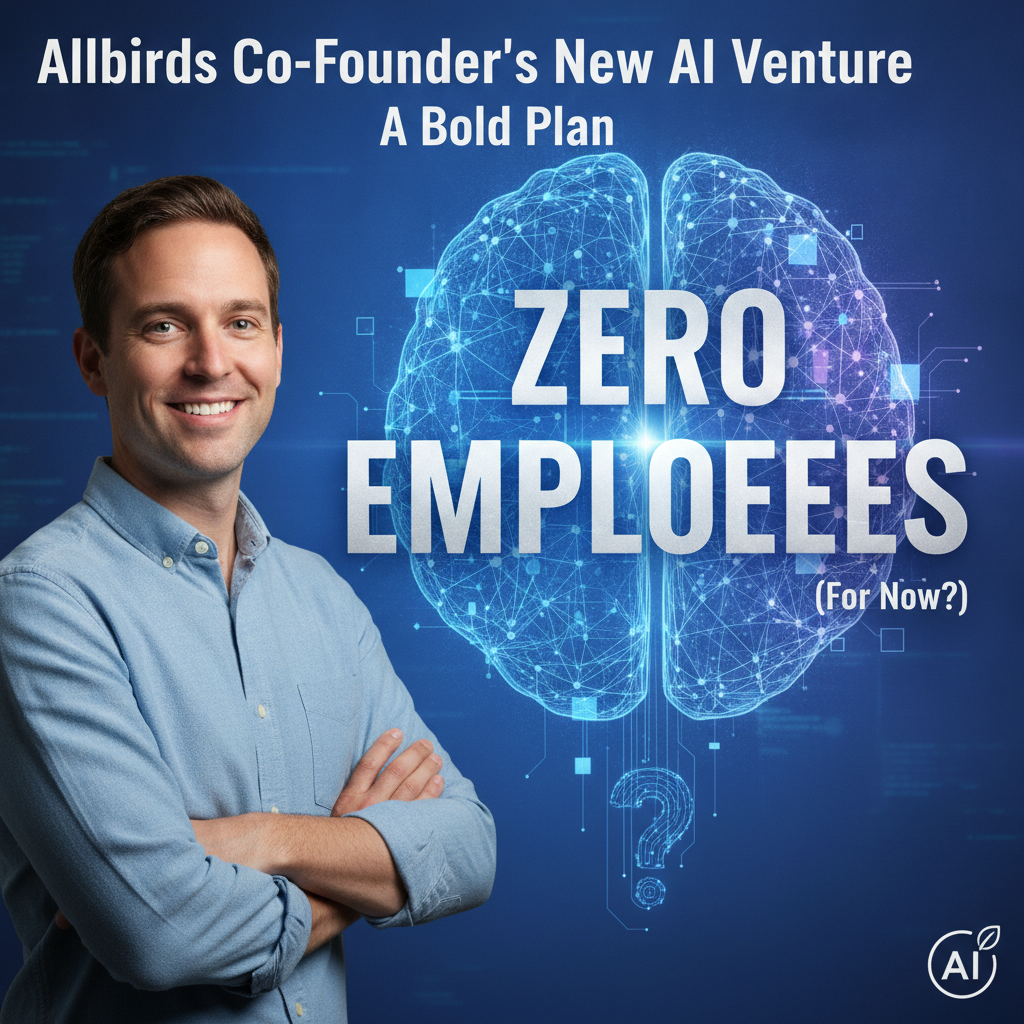
TechCrunch reports on a groundbreaking, hyper-lean AI startup from a seasoned entrepreneur. What does this mean for the future of business?
The business world is no stranger to ambitious ventures, but a recent report from TechCrunch has turned heads: Joey Zwillinger, the visionary co-founder behind the sustainable footwear phenomenon Allbirds, is launching a new AI business with a significant plan – and, remarkably, no employees.
This isn’t just another tech startup; it signals a potentially seismic shift in how companies are conceived, built, and scaled in the age of advanced artificial intelligence. Zwillinger’s move challenges conventional wisdom, suggesting a future where groundbreaking innovation might spring from ultra-lean, AI-centric operations.
The Vision Unveiled: AI at the Core of a New Business Model
While specifics about the new AI venture are still emerging, the very premise from an entrepreneur of Zwillinger’s caliber speaks volumes. Allbirds disrupted the footwear industry by prioritizing sustainable materials and a direct-to-consumer model. It’s highly probable that his new AI endeavor will carry a similar ethos of innovation and efficiency.
What kind of AI business could thrive without a traditional workforce? We can speculate on several possibilities:
- Deep Research & Development: An AI focused on accelerating scientific discovery, perhaps in material science (tying into his Allbirds roots), biotech, or energy efficiency.
- Hyper-Automated Services: A platform leveraging AI to provide complex services (e.g., advanced analytics, specialized consulting, design automation) with minimal human intervention.
- Infrastructure for AI Development: Tools and platforms that empower other AI developers, requiring a highly technical, self-automating core.
The “plan” likely hinges on a sophisticated AI framework capable of handling tasks traditionally performed by multiple departments – from data analysis and strategy formulation to initial product development and even communication.
The “No Employees” Paradox: A Blueprint for the Future?
This is arguably the most striking detail. In an era where tech companies are constantly competing for top talent, Zwillinger’s decision to launch with “no employees” is a bold statement. It suggests an almost absolute faith in the power of artificial intelligence to not just support, but fundamentally operate the core functions of a business.
What makes this possible?
- Advanced Generative AI: Tools capable of generating code, content, designs, and even strategic insights could automate vast swathes of early-stage work.
- Hyper-Automation Platforms: Integrating sophisticated AI with cloud infrastructure and automation tools can create a powerful operational backbone.
- Fractional or Contractual Expertise: While no full-time employees, the venture might utilize highly specialized, short-term contractors for specific legal, financial, or regulatory needs, keeping the core team (even if it’s just Zwillinger himself) incredibly lean.
- Founder-Led Execution: Initially, Zwillinger himself, empowered by AI, might serve as the primary “operator,” leveraging the AI for scalability.
The advantages are clear: immense agility, significantly reduced overhead, and an inherent focus on AI as the company’s central nervous system from day one. However, the challenges are equally profound: how to scale human creativity, navigate complex human-centric problems, and build a culture around a purely AI-driven core.
From Sustainable Footwear to AI Frontiers: Zwillinger’s Next Leap
Joey Zwillinger’s track record with Allbirds demonstrates a penchant for disrupting established industries with innovative models. Allbirds didn’t just sell shoes; it sold a story of sustainability and comfort, built on thoughtful design and a direct relationship with consumers.
His move into AI is not just a pivot to a hot sector; it reflects a deeper understanding of future capabilities. It’s likely that his new AI venture will also seek to solve complex problems, perhaps with an eye toward efficiency, ethical development, or a new form of value creation that only AI can unlock. The entrepreneurial spirit of iterating quickly and challenging norms, so evident in Allbirds, will undoubtedly influence this new AI endeavor.
Implications for the Startup Ecosystem and Future of Work
Zwillinger’s “AI biz with a plan, but no employees” concept is more than a fascinating anecdote; it’s a potential harbinger of things to come. If successful, it could:
- Redefine Startup Scaling: Investors might increasingly look for ventures that can demonstrate a high degree of AI automation and capital efficiency from the outset.
- Shift Talent Acquisition: Future startups might initially seek AI platforms and highly skilled contractors over a large internal team.
- Spur Innovation in AI Infrastructure: Demand will grow for even more powerful, autonomous AI tools capable of running entire business functions.
- Raise Ethical Questions: The development and governance of such AI-centric entities will prompt important discussions around accountability and societal impact.
It’s a testament to the rapid advancements in AI that such a venture is not just conceivable but actively being pursued by a seasoned founder. The traditional Silicon Valley model of rapid hiring and scaling might face a serious contender in the ultra-lean, AI-native startup.
Conclusion: A Glimpse into Tomorrow’s Business Landscape
Joey Zwillinger’s new AI business is poised to be a fascinating experiment and a significant case study. With a clear plan and the unparalleled capabilities of AI, this venture could offer a blueprint for the next generation of entrepreneurial endeavors – businesses that prioritize intelligent automation and efficiency from their very genesis.
Whether this marks the beginning of a widespread trend or a unique outlier remains to be seen. But one thing is clear: the future of work and enterprise is being rapidly reshaped, and entrepreneurs like Zwillinger are at the forefront, pushing the boundaries of what’s possible with artificial intelligence.
Leave a Reply