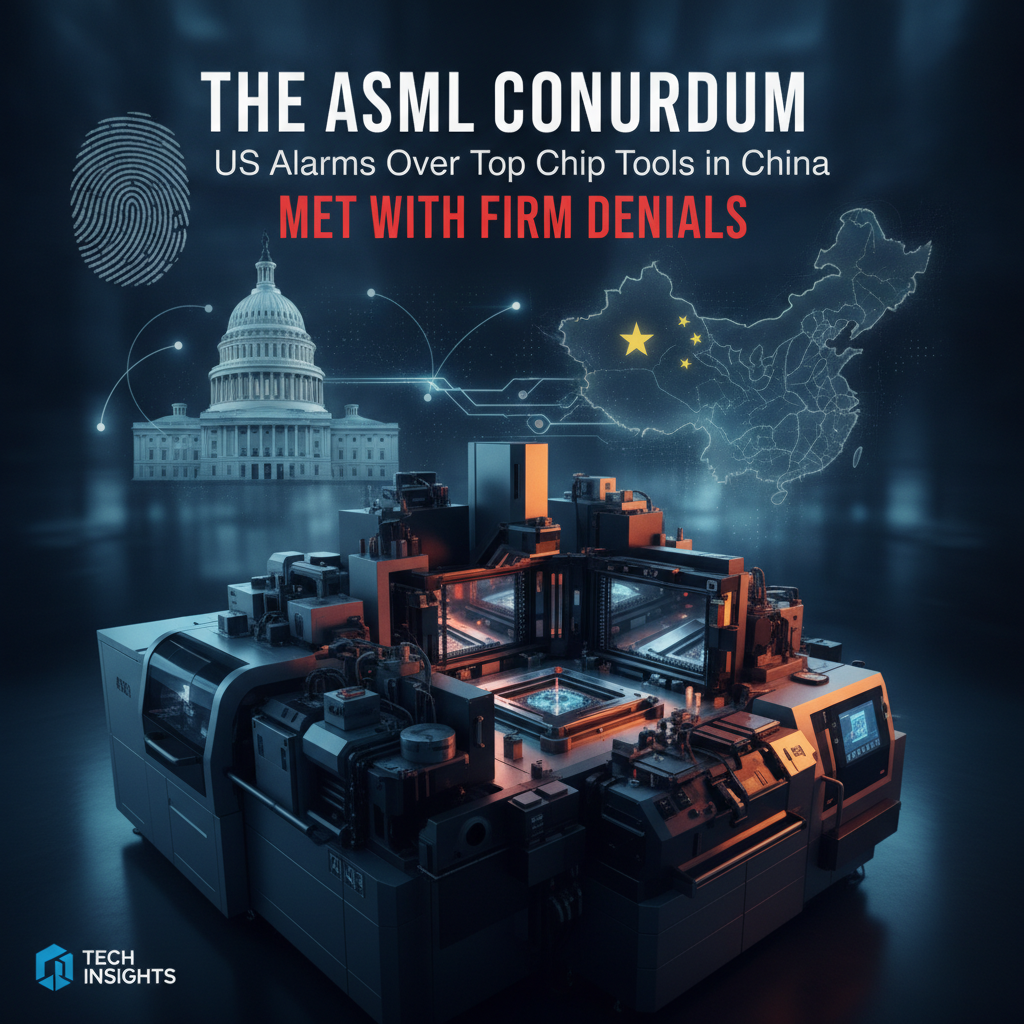
In the high-stakes world of semiconductor manufacturing, few companies hold as much sway as Dutch giant ASML. As the sole producer of Extreme Ultraviolet (EUV) lithography machines—essential for crafting the most advanced microchips—ASML finds itself consistently at the epicenter of geopolitical tensions, particularly concerning US-China tech rivalry. A recent development has reignited this scrutiny: reports of US officials expressing concern that ASML’s most advanced chip tools might have found their way to China, a claim ASML has vehemently denied.
This evolving narrative underscores the intricate dance between national security interests, technological dominance, and global commerce, with ASML navigating a perilous path between the world’s two largest economies.
ASML’s Indispensable Technology: The Heart of the Matter
To understand the gravity of the US’s concern, one must first grasp ASML’s unique position. Its EUV lithography systems are not just ‘chip tools’; they are the pinnacle of precision engineering, enabling chipmakers to print circuits at nanoscale dimensions previously unimaginable. Without ASML’s EUV machines, producing the cutting-edge processors found in the latest smartphones, AI accelerators, and advanced military hardware is virtually impossible. This makes ASML a critical choke point in the global semiconductor supply chain, and its technology a highly coveted—and fiercely protected—asset.
For years, the US has pressured the Netherlands, ASML’s home country, to restrict the sale of its advanced equipment to China, citing national security concerns and the potential for such technology to bolster China’s military capabilities. While ASML has complied with restrictions on EUV sales to China, the latest reports suggest anxieties over other sophisticated DUV (Deep Ultraviolet) systems or even the unauthorized transfer of existing equipment.
US Export Controls and Mounting Suspicions
The United States has progressively tightened its export controls aimed at curbing China’s access to advanced semiconductor technology. These measures are designed to slow Beijing’s indigenous chip development and maintain Washington’s technological lead. The underlying fear is that if China gains unfettered access to leading-edge chip manufacturing capabilities, it could shift the global power balance, both economically and militarily.
Against this backdrop, any suggestion that ASML’s ‘top chip tool’ – interpreted by many as an EUV machine or a highly sophisticated DUV system crucial for advanced node manufacturing – could be in China is a major red flag for US policymakers. Such a presence would represent a significant loophole in the existing control regime and a direct challenge to US strategic objectives.
ASML’s Firm Rebuttal: “It Isn’t”
In response to these allegations, ASML has unequivocally pushed back. The company’s stance is clear: it operates under strict compliance with all relevant export control laws and regulations, including those imposed by the Dutch government and international agreements. ASML has repeatedly affirmed its commitment to adhering to these rules, which currently prohibit the sale of its most advanced EUV technology to China.
ASML’s denial suggests a robust internal compliance framework and a strong confidence in its ability to track its equipment globally. The implications of a breach would be catastrophic for the company, jeopardizing its relationships with key governments and customers worldwide. Therefore, ASML’s public denial carries significant weight and likely reflects a thorough internal investigation into the US claims.
Broader Implications for the Global Semiconductor Landscape
This latest dispute, regardless of its ultimate veracity, highlights several critical implications for the global technology ecosystem:
- Heightened Scrutiny on ASML: The company will likely face even more intense scrutiny from US and allied governments regarding its sales, servicing, and end-user tracking practices in China.
- China’s Persistent Drive: Beijing’s relentless pursuit of semiconductor self-sufficiency will continue, potentially spurring further domestic innovation and investment in alternative technologies, even if less advanced.
- Supply Chain Volatility: The ongoing tech war introduces further uncertainty into an already complex global semiconductor supply chain, affecting manufacturing plans and investment decisions worldwide.
- Allied Unity Test: The incident tests the unity among US allies, particularly the Netherlands, regarding the enforcement and expansion of tech export controls against China.
Navigating the Future: Compliance, Innovation, and Diplomacy
The ASML conundrum is a microcosm of the larger geopolitical forces shaping the 21st century. For ASML, the challenge lies in balancing its commercial interests in a massive market like China with its critical role in the global tech supply chain and its obligations to international compliance. For the US, the incident reaffirms the complexities of enforcing tech restrictions in a globally interconnected industry.
Ultimately, the resolution of such disputes will require a delicate blend of diplomatic engagement, robust compliance mechanisms, and a clear understanding of the technological frontiers. As ASML continues to innovate at the cutting edge of chip manufacturing, it will remain a central figure in the geopolitical chessboard, its every move scrutinized by nations vying for technological supremacy.
The world watches as this saga unfolds, understanding that the future of technology and global power dynamics may well be etched into silicon, with tools from companies like ASML at the very core.
Leave a Reply