
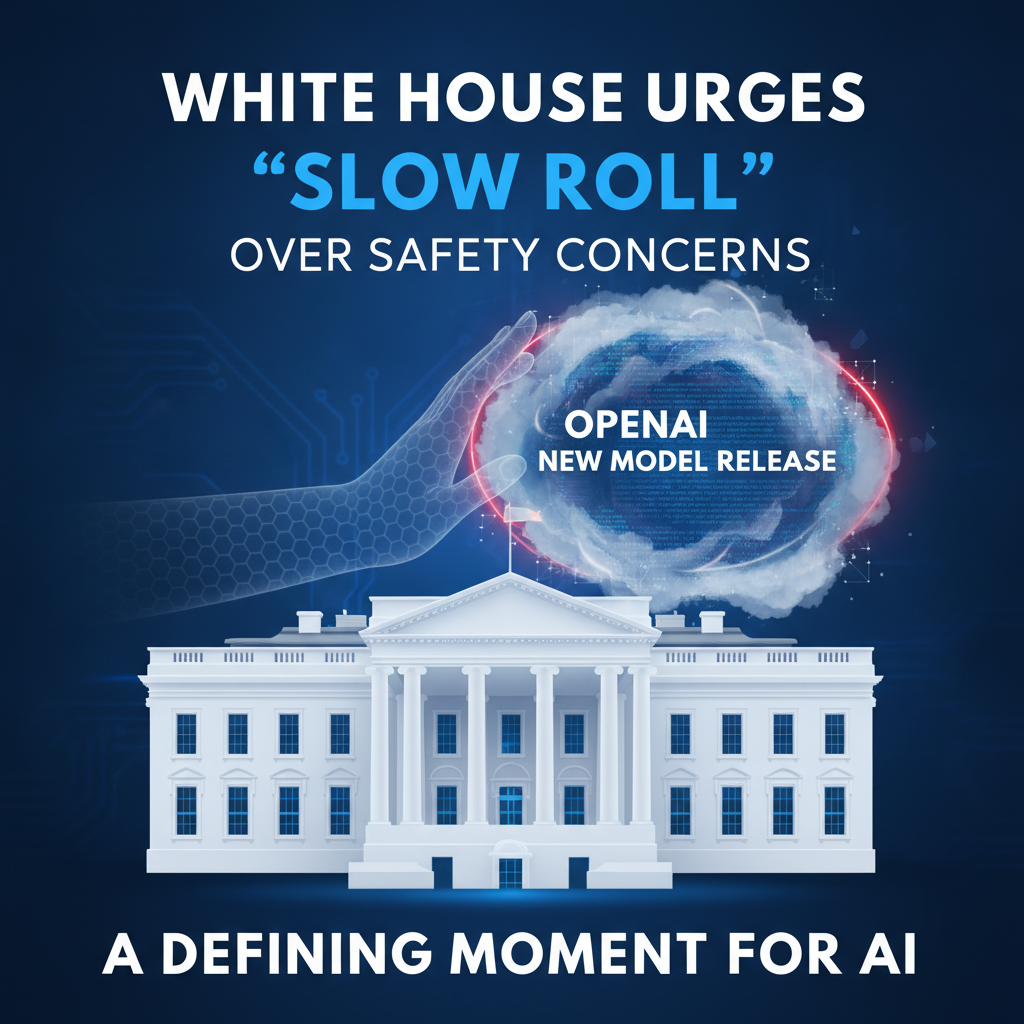
In a move that underscores the rapidly escalating dialogue between innovation and caution, the White House has reportedly asked leading AI research company OpenAI to significantly delay the release of its highly anticipated new model. The request stems from profound safety concerns, signaling a critical juncture in how artificial intelligence is developed, deployed, and governed.
This unprecedented intervention by the U.S. government into the release schedule of a private tech company’s core product highlights a growing global anxiety surrounding the unchecked acceleration of AI capabilities. As advanced AI models become more powerful and pervasive, the call for greater oversight and responsible development is reaching a fever pitch.
The White House’s Stance: Prioritizing Precaution Over Progress?
The Biden administration’s proactive engagement with OpenAI isn’t an isolated incident but rather a continuation of its efforts to grapple with the complexities of AI. Driven by insights from leading AI ethicists, scientists, and policymakers, the White House is keen to establish guardrails before potential harms become irreversible. While the specifics of OpenAI’s new model remain under wraps, it’s widely speculated to represent a significant leap forward in generative AI, potentially surpassing previous iterations in areas like reasoning, creativity, and autonomous function.
The government’s primary concerns likely revolve around a spectrum of risks:
- Misinformation and Disinformation: The potential for highly sophisticated AI to generate hyper-realistic fake content at an unprecedented scale, impacting elections, public health, and social cohesion.
- Security Vulnerabilities: AI’s potential misuse in cyber warfare, developing novel bioweapons, or autonomous weapons systems.
- Bias and Fairness: Amplification of societal biases embedded in training data, leading to discriminatory outcomes in critical sectors like employment, justice, and healthcare.
- Economic Disruption: Rapid and widespread job displacement without adequate societal preparation.
- Existential Risks: While speculative, concerns about AI developing unintended or uncontrollable behaviors that pose fundamental threats to humanity are gaining traction among some experts.
The White House’s request suggests a move towards a ‘precautionary principle,’ where potential risks are thoroughly assessed and mitigated before widespread deployment, even if it means slowing down technological advancement.
OpenAI’s Dilemma: Innovation vs. Responsibility
OpenAI, known for its mission to ensure that artificial general intelligence (AGI) benefits all of humanity, now finds itself in a precarious position. On one hand, the company is under immense pressure to innovate, demonstrate leadership in a fiercely competitive market, and satisfy its investors. On the other, its foundational principles commit it to responsible development and safety.
A ‘slow roll’ could involve:
- Extended Red-Teaming: More rigorous and prolonged testing by internal and external experts to identify and address vulnerabilities.
- Public Consultation: Engaging with a broader range of stakeholders, including civil society, academics, and international bodies, to gather feedback.
- Developing Robust Safeguards: Implementing advanced mechanisms to detect and prevent misuse, embed ethical guidelines, and ensure transparency.
- Regulatory Framework Discussions: Collaborating with governments to help shape effective and adaptive regulatory approaches.
Delaying a major product release is a significant business decision, potentially impacting market share and investor confidence. However, demonstrating a commitment to safety and collaboration with government bodies could ultimately bolster public trust and establish OpenAI as a leader in responsible AI development.
The Broader Implications for AI Development and Regulation
This incident sets a powerful precedent. It signals a shift from purely voluntary industry guidelines to more direct government intervention in the pace and direction of AI innovation. The implications are far-reaching:
Increased Scrutiny for Frontier AI Models
All future large language models and frontier AI systems from other developers like Google, Meta, and Anthropic are likely to face similar, if not greater, scrutiny. The era of releasing powerful AI models with minimal external review may be drawing to a close.
Push for Industry Standards and Global Cooperation
The White House’s move could galvanize efforts to establish industry-wide safety standards, auditing protocols, and responsible deployment frameworks. Furthermore, AI’s global nature necessitates international cooperation, and this event might accelerate discussions on cross-border AI governance.
The Evolving Role of Government
Governments worldwide are grappling with how to regulate a technology that evolves at an exponential rate. This intervention indicates a willingness to move beyond policy papers and engage directly with developers on specific product releases, marking a more assertive role for public bodies in technological oversight.
Striking the Balance: Innovation, Safety, and Trust
The tension between accelerating innovation and ensuring safety is perhaps the defining challenge of our technological age. While some argue that slowing down AI development could cede leadership to less scrupulous actors or hinder progress on critical applications like drug discovery and climate modeling, others contend that a pause is necessary to avoid catastrophic outcomes.
The White House’s request to OpenAI is a stark reminder that the future of AI is not solely in the hands of its creators. It is a shared responsibility, demanding continuous dialogue, transparent processes, and a commitment from all stakeholders to build a future where AI serves humanity safely and ethically.
As OpenAI navigates this complex demand, the world watches closely. The outcome of this ‘slow roll’ will undoubtedly shape not just the trajectory of one company’s product, but the very framework for AI governance for years to come.