
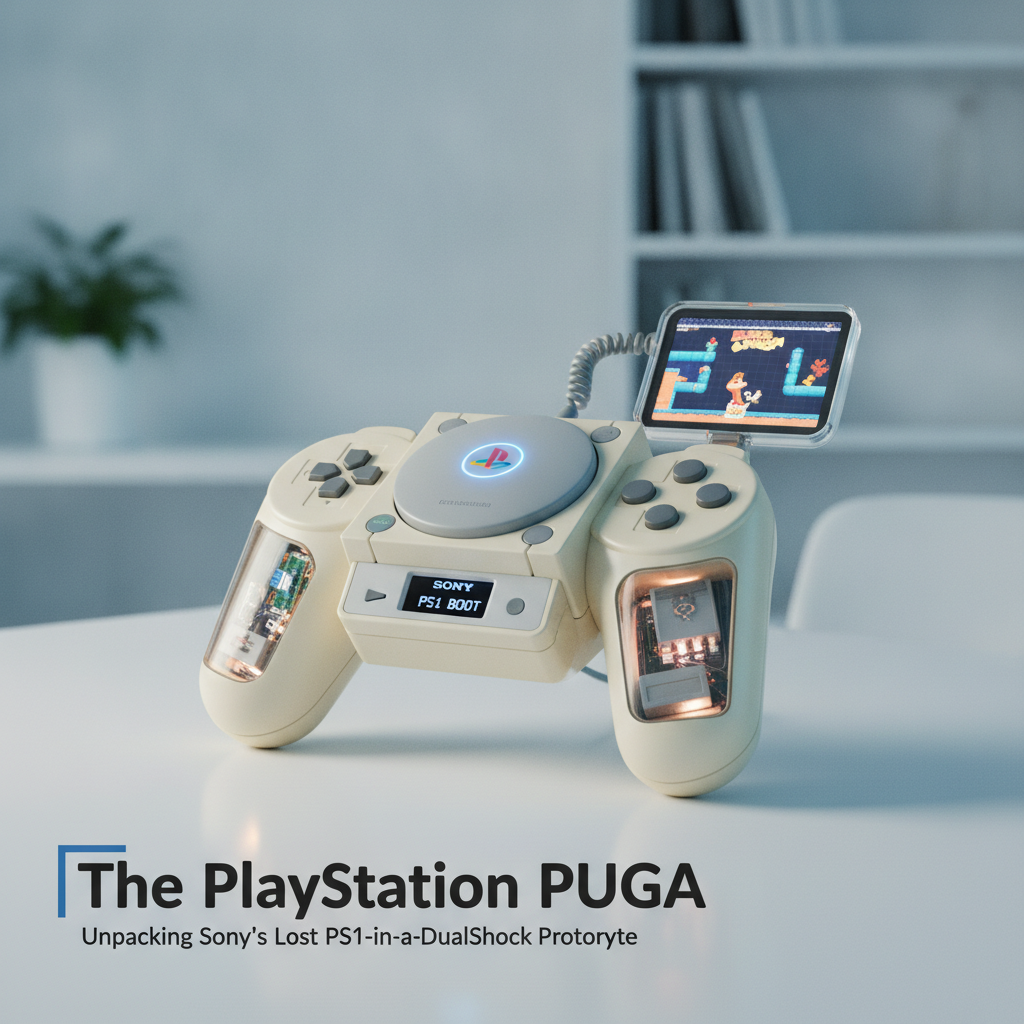
In the annals of gaming history, there are countless tales of groundbreaking successes, monumental failures, and a fascinating category in between: the prototypes that never saw the light of day. Among these hidden gems is one of the most intriguing PlayStation curiosities: the PlayStation PUGA. Imagine a full-fledged PlayStation 1 console discreetly tucked inside a DualShock controller. Sounds like science fiction, right? Yet, this ambitious project was very real, a testament to Sony’s relentless innovation. So, what exactly was the PUGA, and why did Sony ultimately pull the plug on such a revolutionary concept?
What Was the PlayStation PUGA? A Console in Your Hands
The PlayStation PUGA (reportedly an internal codename, sometimes associated with the model number SCPH-9000, though this is often debated with the final PSOne model) was far more than just a concept drawing. It was a functional prototype, a marvel of miniaturization that aimed to cram the entirety of a PlayStation 1’s hardware into the shell of a standard DualShock controller. While precise details about its internal layout remain shrouded in mystery, the core idea was astonishing: plug this controller into a TV, and you’d be playing PS1 games directly from it.
This wasn’t just a controller with a game or two pre-loaded; it was designed to be the console itself. It would have featured a disc drive (likely a compact, top-loading mechanism, or even a slot-loading one, although photos suggest a more traditional approach if it existed outside renders), memory card slots, and all the necessary ports to connect to a television and power supply. The vision was clear: to offer the ultimate in plug-and-play nostalgia, making the PS1 experience more accessible and perhaps even more portable than ever before.
Sony’s Experimental Era: Pushing Boundaries
The PUGA wasn’t an isolated flight of fancy. It emerged during a period when Sony was constantly experimenting with new form factors and hardware innovations. This was the same company that later gave us the compact PSOne with its optional LCD screen, and eventually, the PSP, a handheld console that redefined portable gaming. The PUGA represented an extreme interpretation of this ethos: reducing the console to its bare minimum, integrating it directly into the primary input device.
Such a device would have perfectly capitalized on the PS1’s massive library of beloved titles, offering a streamlined way for gamers to revisit classics without needing a separate console unit. It promised convenience and a futuristic aesthetic that still captivates imaginations today.
Why Sony Pulled the Plug: The Unspoken Challenges
Despite its undeniable coolness factor, the PlayStation PUGA never made it to market. The reasons for its cancellation are multi-faceted and likely a blend of technical hurdles, market strategy shifts, and economic realities:
- Manufacturing Complexity & Cost: Integrating a full PS1 motherboard, a disc drive, cooling solutions, and all necessary ports into a DualShock’s relatively cramped space would have been incredibly complex and expensive. The miniaturization required would have pushed component costs significantly higher than a traditional console.
- Heat Dissipation: A major challenge for any compact electronic device is heat management. A PS1 running games generates considerable heat, and venting that safely and effectively from a controller-sized shell without making it uncomfortable to hold or risking component failure would have been a significant engineering feat.
- Ergonomics & Practicality: While innovative, the ergonomics of a controller housing a disc drive and other components would have been questionable. It would undoubtedly have been heavier and bulkier than a standard DualShock, potentially impacting player comfort during long gaming sessions. Where would the disc sit comfortably without obstructing hands?
- Market Timing & Strategy: The PUGA concept likely emerged around the turn of the millennium, a period when Sony was heavily invested in the PlayStation 2. Releasing a high-tech, potentially expensive PS1 variant might have diluted focus from their next-generation console. Furthermore, the existing PSOne model, a highly successful compact revision, already offered a streamlined PS1 experience, perhaps making the PUGA redundant or less necessary.
- Technological Limitations: At the time, components like small, efficient disc drives and powerful, low-heat-generating processors were not as readily available or affordable as they are today. The technology simply wasn’t quite there to make the PUGA a mass-market, cost-effective reality.
The PUGA’s Lasting Legacy: A Glimpse of What Could Have Been
Even though the PlayStation PUGA remains a phantom limb of gaming history, its story resonates deeply with enthusiasts. It serves as a powerful reminder of Sony’s willingness to experiment and innovate, even if not every idea comes to fruition. It fuels the imagination of what gaming could have looked like and stands as a testament to the wild, creative energy of the industry’s golden age.
Today, with the rise of mini-consoles like the PlayStation Classic and the continued demand for retro gaming experiences, the PUGA’s vision of an all-in-one, plug-and-play solution feels almost prophetic. While it never graced our living rooms, the legend of the DualShock that packed a full PS1 ensures its place as one of the most intriguing “what ifs” in PlayStation lore.
Share Your Thoughts!
What do you think of the PlayStation PUGA? Would you have bought one? Share your thoughts in the comments below!
Leave a Reply