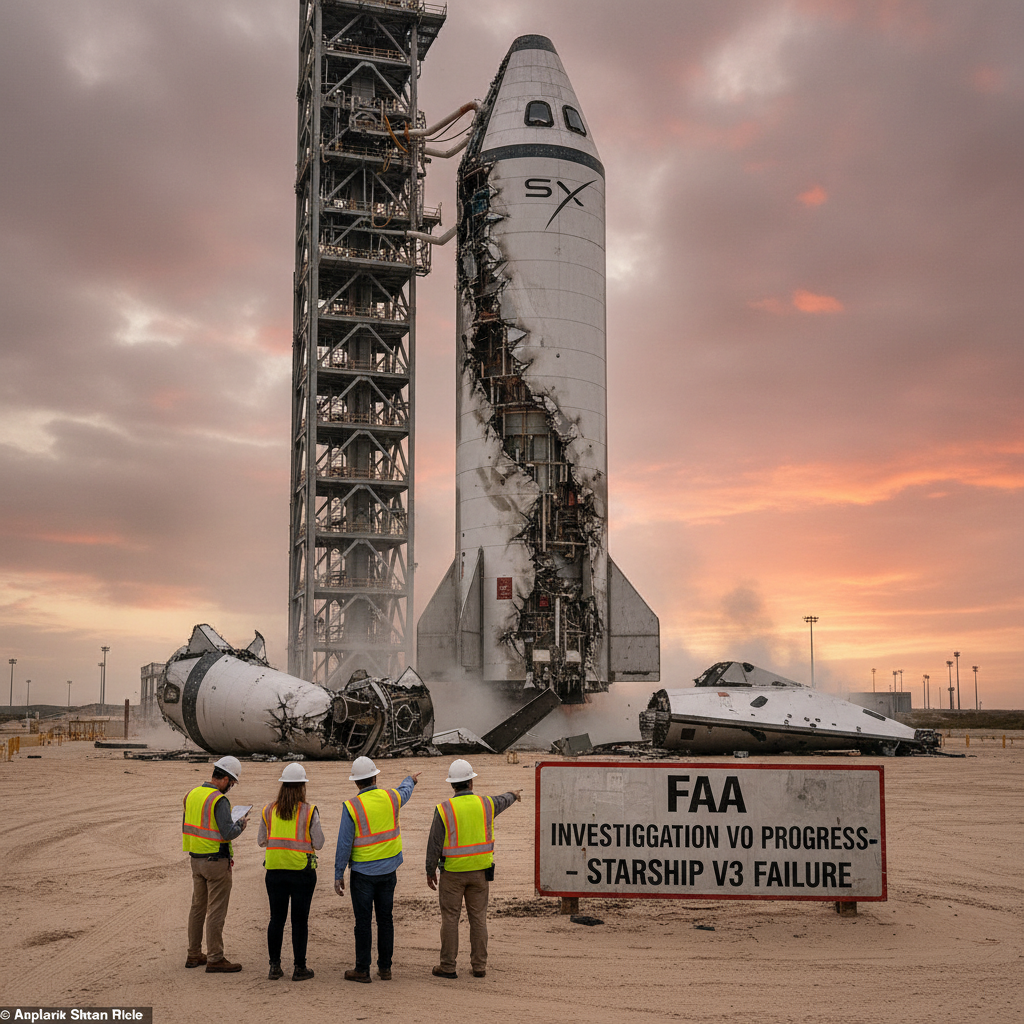
In a significant development for the commercial space industry, the Federal Aviation Administration (FAA) has formally ordered SpaceX to launch a comprehensive investigation into the recent failure of a Starship V3 booster. The incident, which occurred during a critical test flight, marks another hurdle for Elon Musk’s ambitious interplanetary transportation system and underscores the rigorous regulatory environment governing private space endeavors.
This mandate from the FAA is standard procedure following any launch or test anomaly involving commercial spaceflight, emphasizing the agency’s unwavering commitment to public safety and environmental protection. For SpaceX, it means a temporary halt to further Starship V3 booster test flights until the root cause of the failure is identified and corrective actions are approved.
The Incident: A Setback for Starship V3 Development
While specific details of the Starship V3 booster failure remain under wraps as the investigation commences, reports indicate the anomaly occurred at a crucial phase of its test sequence. This particular version, Starship V3, represents SpaceX’s latest iteration aimed at increasing reliability and performance for its eventual Mars missions and lunar landings.
Each Starship prototype and booster test provides invaluable data, pushing the boundaries of rocket engineering. However, failures, while often part of an iterative development process, trigger immediate regulatory scrutiny. The FAA’s involvement ensures a meticulous examination, far beyond internal company reviews, to ascertain that public safety is not compromised by future launches.
FAA’s Role: Ensuring Safety and Compliance in Commercial Space
The FAA’s Office of Commercial Space Transportation (AST) is responsible for regulating U.S. commercial space launch and reentry operations. Its primary goal is to protect the public, property, and the national security and foreign policy interests of the United States. Following an anomaly, the FAA:
- Oversees the investigation: Ensures SpaceX conducts a thorough root cause analysis.
- Reviews findings: Evaluates SpaceX’s investigation report, proposed corrective actions, and their implementation.
- Approves return to flight: Grants permission for future launches only after verifying that all safety concerns have been addressed and the vehicle is safe to fly.
This stringent oversight is a cornerstone of the burgeoning commercial space industry, balancing innovation with indispensable safety protocols. The FAA’s order is not merely punitive; it’s a procedural step designed to prevent future incidents and maintain the high safety standards expected of spaceflight operations.
Implications for SpaceX and the Starship Program
For SpaceX, this investigation means potential delays to its aggressive Starship development and testing schedule. The company has famously adopted a rapid, iterative approach, learning from each test flight, successful or otherwise. However, an FAA-mandated investigation adds a layer of external review and approval that can extend timelines.
Key implications include:
- Development Slowdown: Further V3 booster tests will be paused, potentially impacting the overall Starship development timeline.
- Resource Allocation: Engineers and resources will be diverted to the investigation, potentially drawing away from other ongoing projects.
- Public and Investor Scrutiny: Heightened attention from the media, public, and investors regarding the program’s progress and safety.
- Licensing Impact: Future launch licenses for Starship could be contingent on the successful resolution of this investigation and implementation of FAA-approved corrective measures.
Despite these challenges, SpaceX has a strong track record of working collaboratively with the FAA to resolve issues and improve its vehicles. This incident, while a setback, is also an opportunity to refine the Starship V3 design and operational procedures, ultimately contributing to a safer and more reliable system.
The Future of Commercial Spaceflight Safety
The Starship V3 booster failure and subsequent FAA order serve as a timely reminder of the inherent risks and complexities of advanced rocketry. As more private companies venture into space, the role of regulatory bodies like the FAA becomes increasingly critical in balancing innovation with public and environmental safety.
This event will undoubtedly spark further discussions within the aerospace community regarding best practices for testing, development, and regulatory compliance in a rapidly evolving industry. Ultimately, a thorough investigation and transparent reporting will benefit not just SpaceX, but the entire commercial space ecosystem by contributing to a safer, more sustainable path to space exploration.
What’s Next for Starship V3?
SpaceX will now assemble an investigation team, working closely with FAA officials. The team will analyze telemetry data, wreckage (if any), and conduct simulations to pinpoint the exact cause of the booster failure. Once the root cause is determined and corrective actions are proposed, these will be submitted to the FAA for approval.
Only after the FAA is satisfied that SpaceX has adequately addressed the failure and implemented all necessary safety measures will the company be permitted to resume Starship V3 booster test flights. The timeline for this process can vary significantly, from weeks to several months, depending on the complexity of the failure and the scope of corrective actions required.
The world watches keenly as SpaceX navigates this latest challenge, with the future of humanity’s multi-planetary ambitions resting on the successful and safe development of Starship.