
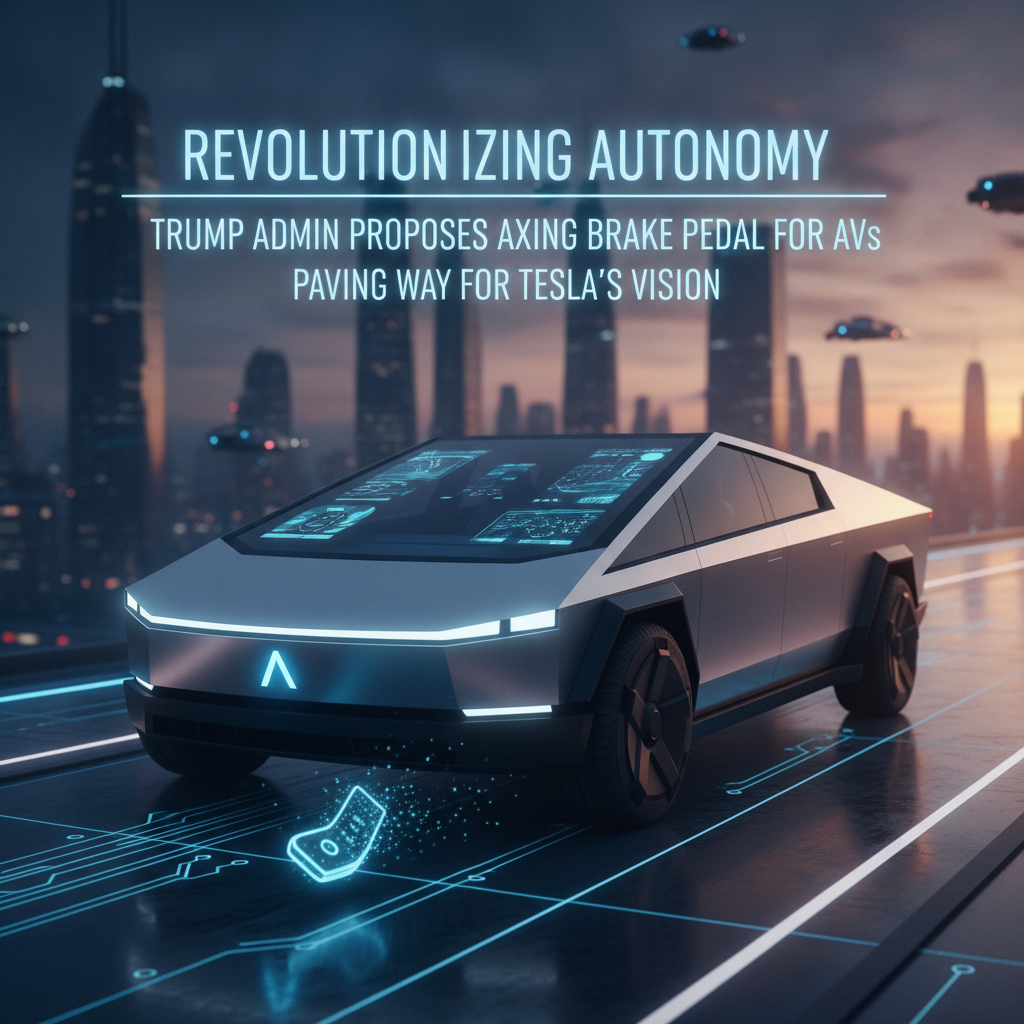
The landscape of autonomous vehicle (AV) regulation is constantly evolving, with policymakers grappling with how to safely integrate self-driving technology into our daily lives. A reported, potentially groundbreaking proposal from the Trump administration could dramatically reshape this future, particularly benefiting companies at the forefront of AV development like Tesla. The proposal? To eliminate the federal requirement for a brake pedal in fully autonomous vehicles.
A Bold Step Towards True Autonomy
Current federal safety standards, established decades ago, mandate that all vehicles sold in the United States include traditional driver controls, most notably a steering wheel and brake pedal. These requirements are rooted in the assumption of human operation, a paradigm that fully self-driving (SAE Level 5) vehicles aim to transcend entirely.
The administration’s reported proposal signals a significant shift in regulatory philosophy. By removing the brake pedal mandate for vehicles designed from the ground up for autonomous operation, it acknowledges that a human driver may not always be present or necessary to intervene. This isn’t just a minor tweak; it’s a fundamental rethinking of what constitutes a ‘vehicle’ in the age of AI.
Why This Matters for the AV Industry
- Unlocking New Designs: Manufacturers would gain unprecedented freedom in interior design. Without the need to accommodate a human driver’s foot controls, cabins could be reimagined as mobile lounges, offices, or entertainment spaces. This could lead to radical innovations in vehicle interiors, moving beyond traditional automotive aesthetics.
- Accelerated Development: Streamlining regulatory hurdles can accelerate the testing and deployment of truly driverless vehicles, reducing development costs and time-to-market for advanced AV systems. This could push the entire industry forward at a faster pace.
- Paving the Way for Level 5: While many AVs currently operate at Level 2 or 3 (requiring human supervision), this move clears a critical regulatory path for Level 4 and Level 5 vehicles, which are designed to operate without any human input under specific or all conditions. It’s a key enabler for the ultimate vision of self-driving cars.
The Tesla Advantage: A Supercharge for FSD
Among all automakers, Tesla stands to gain significantly from such a regulatory change. Here’s why:
- Pioneer in Full Self-Driving (FSD): Tesla has consistently pushed the boundaries of autonomous driving, with its FSD beta program already testing advanced capabilities. Removing physical controls aligns perfectly with their long-term vision of a car that truly drives itself, requiring no human intervention.
- Minimalist Interior Philosophy: Tesla’s current vehicle interiors are already known for their minimalist design, often centered around a large touchscreen interface. Eliminating the brake pedal further empowers their design team to innovate, potentially leading to even more radical, user-centric cabin experiences. Imagine a future Tesla where the entire dashboard is a media console, and the front seats swivel for communal interaction.
- Reduced Manufacturing Complexity: For vehicles designed exclusively for autonomous use, removing redundant mechanical components like the brake pedal mechanism could simplify manufacturing processes and potentially reduce costs, though this would apply more to purpose-built robotaxis than consumer vehicles initially.
- Brand Alignment: This move perfectly reinforces Tesla’s brand identity as a leader in future-forward automotive technology, separate from traditional carmakers, further solidifying their position at the cutting edge of innovation.
Safety and Public Perception: The Roadblocks Ahead
While exciting for proponents of autonomous technology, axing a fundamental control like the brake pedal inevitably raises critical questions and concerns:
- Safety Protocols: How will emergency braking be ensured and tested without a human-operable pedal? Robust redundant electronic systems and failsafe mechanisms, along with rigorous certification processes, will be paramount to ensure passenger safety.
- Public Trust: Convincing the public that a vehicle without a brake pedal is safe will be a significant challenge. Extensive public education campaigns, transparent safety data, and demonstrable track records will be crucial to building confidence.
- Transitional Period: What about hybrid models or situations where a vehicle might operate autonomously but also require occasional human input? Clear distinctions and regulations for different levels of autonomy will be essential to avoid confusion and ensure safety during the transition.
- Liability: In the event of an accident, the absence of human controls further solidifies the manufacturer’s liability, a complex legal area still under development that will require clear frameworks.
The Future of Driverless Cars: A Glimpse into Tomorrow
This proposal, if enacted, marks a pivotal moment for the autonomous vehicle industry. It shifts the regulatory focus from human-centric controls to a software and sensor-driven paradigm. While it might take years for such truly pedal-less vehicles to become commonplace on public roads, the administrative groundwork being laid today could accelerate that transition significantly.
The ultimate goal is a transportation system that is safer, more efficient, and more accessible. Removing legacy requirements like the brake pedal is a bold step towards fully realizing that vision, placing the onus squarely on the sophisticated AI and robust engineering of the autonomous systems themselves. It signals a future where the car is no longer just a means of transport but a truly intelligent, self-sufficient entity.
Conclusion
The Trump administration’s reported proposal to remove the brake pedal requirement for autonomous vehicles is more than just a regulatory change; it’s a statement of intent for the future of transportation. For pioneers like Tesla, it offers a direct path to implement their radical visions for fully self-driving cars, unencumbered by traditional design constraints. As the debate unfolds, the balance between innovation, safety, and public acceptance will define the pace at which this truly driverless future arrives.
What are your thoughts on a car without a brake pedal? Do you believe it’s a necessary step for true autonomy, or a bridge too far for safety? Share your perspective in the comments below!
Leave a Reply