
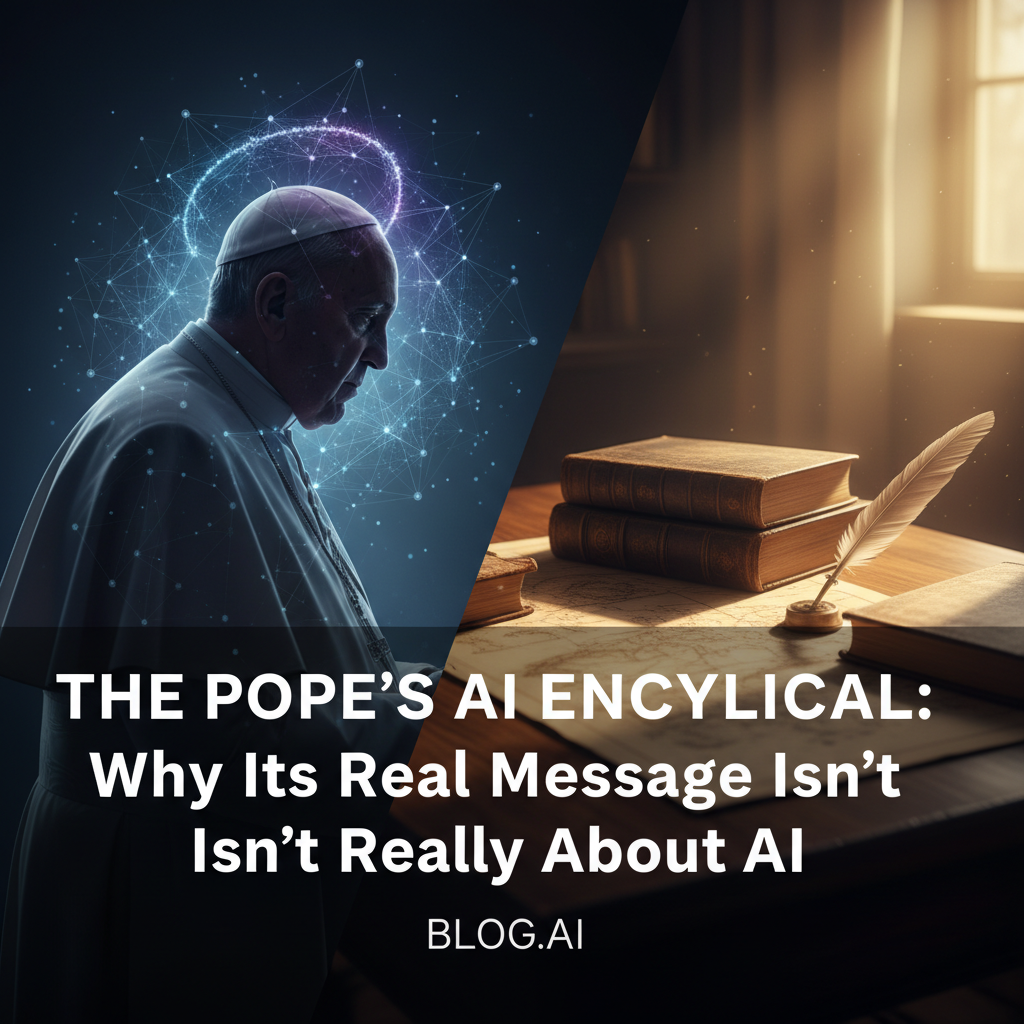
In an age increasingly defined by algorithms and artificial intelligence, the anticipation of a Papal Encyclical addressing AI itself is both groundbreaking and, upon closer inspection, deeply characteristic of the Vatican’s enduring mission. As the tech world buzzes with speculation about its contents and implications for responsible innovation, the most profound insight might be this: the Pope’s AI encyclical isn’t really about AI at all.
Beyond the Code: AI as a Mirror to Humanity
At its core, AI is a human creation, a reflection of our ingenuity, biases, and aspirations. When the Church, through an encyclical, addresses artificial intelligence, it inevitably uses AI as a lens to scrutinize something far older and more central: humanity itself. The document will likely delve into fundamental questions that AI forces us to confront:
- What defines human dignity in an era where machines exhibit intelligent behavior?
- How do concepts like consciousness, free will, and creativity distinguish us from even the most advanced algorithms?
- What responsibilities do we bear when creating entities that mimic human thought and interaction?
The Vatican’s consistent emphasis on the intrinsic value of every human person, from conception to natural death, provides the bedrock for this discussion. AI doesn’t change this value; it merely highlights our need to reaffirm and protect it in new, technologically advanced contexts. The encyclical will likely urge us to ensure AI development remains oriented towards human flourishing, not merely technological advancement.
The Ethical Imperative: Morality, Not Just Machines
While the encyclical might touch upon technical aspects of AI, its true focus will undoubtedly be on the ethical and moral frameworks necessary to guide its development and deployment. The Church isn’t a Silicon Valley startup; its expertise lies in moral theology and social justice, not deep learning architectures or neural networks.
Expect the document to address universal challenges in the realm of AI ethics, such as:
- Bias and Fairness: How do we ensure AI systems do not perpetuate or amplify existing societal inequalities and injustices?
- Accountability and Transparency: Who is responsible when AI makes critical decisions, and how can we understand its reasoning?
- The Common Good: How can AI be leveraged to serve all of humanity, particularly the most vulnerable, rather than just a privileged few?
- Work and Dignity: What are the implications for human labor, purpose, and the economy when automation scales, and how can human work remain central?
These are not merely technical challenges; they are profound ethical dilemmas that demand a universal moral compass, precisely what a Papal Encyclical aims to provide.
Power, Global Solidarity, and Integral Human Development
Another crucial layer beneath the surface of AI lies the issue of power. Who designs, owns, and controls this transformative technology? The concentration of AI capabilities in the hands of a few corporations or nations poses significant risks to global solidarity and equitable development. The social impact of AI, particularly on developing nations, will be a central concern.
The encyclical will likely extend the Church’s long-standing teachings on social justice, emphasizing the need for:
- Equitable Access: Ensuring that the benefits of AI are shared broadly, preventing a new form of digital divide that separates the technologically empowered from the disenfranchised.
- Responsible Governance: Calling for international cooperation and ethical regulations to steer AI development towards human-centered outcomes.
- Subsidiarity: Respecting local communities and human agency in adopting and adapting AI technologies, rather than imposing top-down solutions.
The document won’t be a technology white paper, but a clarion call for an AI that serves integral human development – intellectual, emotional, social, and spiritual – for all people, fostering a more just and inclusive global society.
The Spiritual Dimension: Purpose, Meaning, and Our Place in Creation
Perhaps the most subtle, yet potent, message of an AI encyclical will reside in its spiritual implications. As AI pushes the boundaries of what machines can do, it inevitably prompts existential questions about human purpose, meaning, and our unique place within creation. The intersection of faith and technology becomes particularly relevant here.
The Church has always grappled with humanity’s relationship with creation and the Creator. AI, as a pinnacle of human creation, provides a fresh context for these eternal inquiries:
- How does AI affect our understanding of divine creation and human co-creation?
- Does the advent of sophisticated algorithms challenge or deepen our faith and our understanding of the sacred?
- How do we maintain a sense of wonder, transcendence, and spiritual connection in a world increasingly mediated by technology?
The encyclical, therefore, serves not just as an ethical guide for technology, but as a spiritual compass, urging us to reflect on our deepest values and ultimate purpose in a rapidly evolving digital landscape.
Conclusion: A Call to Discernment, Not Just Development
Ultimately, the Pope’s AI encyclical, while ostensibly about artificial intelligence, will be a profound meditation on human nature, ethics, social justice, and spirituality in the 21st century. It will treat AI not as an isolated technological phenomenon, but as a powerful catalyst that brings into sharp relief our most pressing human challenges and our most enduring spiritual questions.
By framing the discussion this way, the Vatican aims to move beyond superficial debates about technological capabilities and instead call humanity to a deeper discernment: not just about what we can build, but about who we are, who we want to be, and what kind of world we choose to create with the formidable tools at our disposal. This isn’t just about AI; it’s about all of us, and the future we’re building together.