
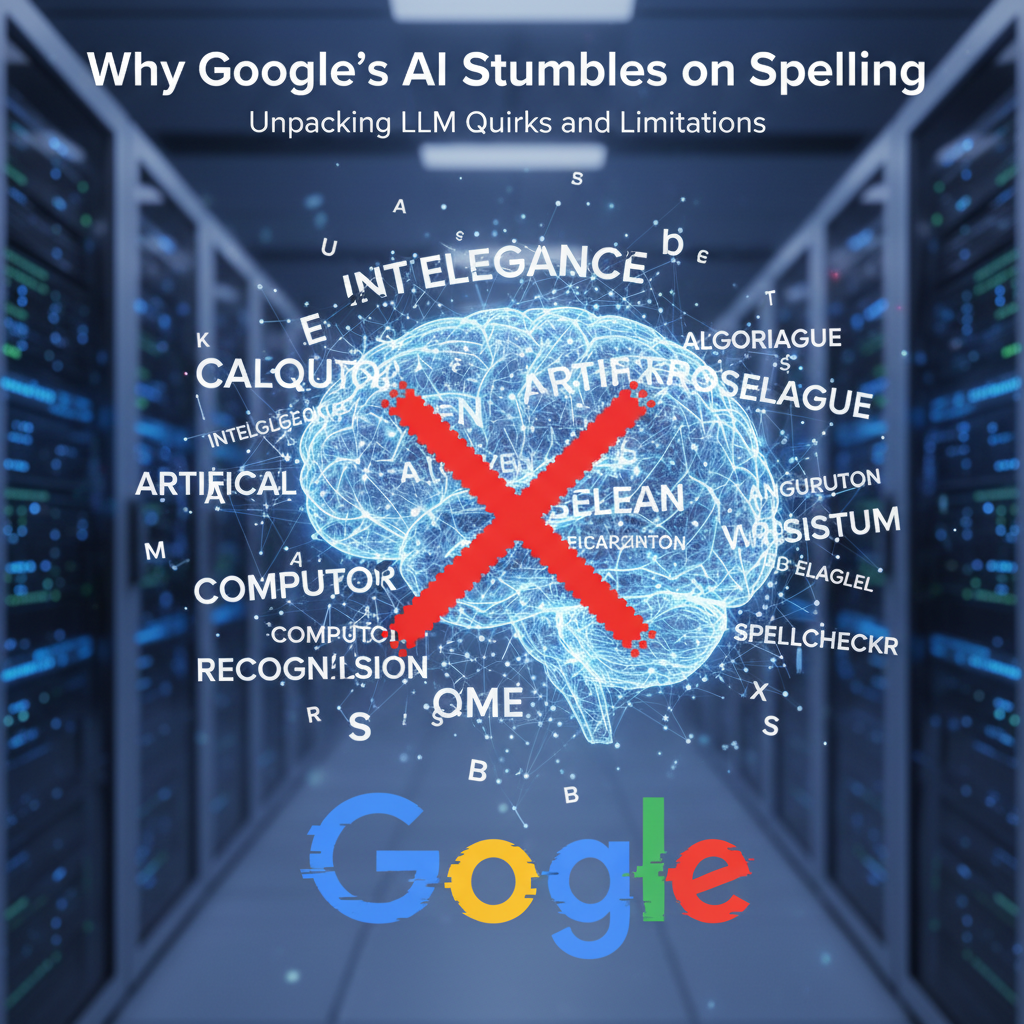
In an era where artificial intelligence writes poetry, composes music, and even diagnoses diseases, there’s a peculiar, almost ironic, flaw that continues to plague even the most advanced models: spelling. Imagine Google’s own AI, a testament to technological prowess, struggling to correctly spell ‘Google.’ It sounds like a paradox, a digital slapstick, yet it highlights a profound architectural reality of Large Language Models (LLMs). This isn’t just a minor glitch; it’s a window into how these complex systems process language, and why sometimes, brilliance comes with a baffling blind spot.
The Paradox: Brilliance Meets Basic Blunder
Modern LLMs, like Google’s Gemini or OpenAI’s GPT series, can perform astonishing feats. They can generate coherent narratives, translate between dozens of languages with impressive nuance, summarize dense documents, and even engage in philosophical debates. Their ability to grasp context, understand complex prompts, and produce human-like text is, frankly, astounding. Yet, ask them to spell a proper noun, a brand name, or even a slightly uncommon word, and you might encounter a peculiar string of characters that leaves you scratching your head. This isn’t necessarily about intelligence; it’s about how they are intelligent.
Why “Learning” Isn’t Always “Knowing” for AI Spelling
To understand why an AI, trained on vast swathes of text, might fumble a basic spelling, we need to look under the hood at how these models process language. It’s fundamentally different from how a human child learns to spell.
Tokens, Not Letters: How LLMs “See” Language
Unlike humans who learn the alphabet and phonetic rules, LLMs primarily operate on ‘tokens.’ A token can be a whole word, a sub-word unit (like ‘un-‘ or ‘-ing’), or even a punctuation mark. When an LLM processes text, it breaks it down into these tokens. It doesn’t typically ‘see’ individual letters in the same granular way. When it generates text, it’s predicting the most probable next token based on the sequence so far, not stringing together letters to form a word based on a dictionary definition or a character-by-character validation.
The Statistical Guessing Game
At its core, an LLM is a sophisticated prediction engine. Given a sequence of tokens, it calculates the statistical probability of the next token. It’s excellent at maintaining semantic flow and grammatical structure because these patterns are abundant in its training data. However, for a specific spelling, especially for proper nouns or less frequent words, the model might prioritize what sounds right or what looks like a common pattern based on its token-level understanding, rather than recalling an exact, character-perfect string. If ‘Google’ is often seen adjacent to ‘search’ or ‘engine,’ the model learns that relationship, but the precise letter sequence might be secondary to the broader contextual token relationships.
The Problem of Infrequent or Novel Words
Proper nouns, new jargon, or very rare words appear less frequently in the vast training datasets compared to common vocabulary. While an LLM might have encountered ‘Google’ millions of times, its internal representation might not be as robust or ‘fixed’ as, say, ‘the’ or ‘a’. When forced to generate such a word without strong statistical priors for its exact spelling in a specific context, it might ‘hallucinate’ a plausible but incorrect version based on similar-sounding tokens or common phonetic patterns.
Specific Challenges for AI Spelling Accuracy
Several factors contribute to these persistent spelling quirks:
- Phonetic Drifts: If an AI’s training data includes spoken language transcripts or common misspellings from online text, it might inadvertently learn and reproduce ‘phonetic’ spellings (e.g., ‘rite’ instead of ‘write’ in certain contexts) if those appear frequently enough.
- Creative Misspellings (Hallucinations): When an AI isn’t simply regurgitating learned patterns but trying to generate genuinely ‘new’ text, it can sometimes invent words or misspell existing ones in its creative process, much like a human might during a typo, but often with less awareness.
- Contextual Overload vs. Precision: In many scenarios, the meaning and context of a sentence are far more important than the absolute perfect spelling of every single word. LLMs are optimized for overall coherence. A minor misspelling might not significantly impact the statistical probability of the subsequent tokens, leading the model to prioritize the broader message over meticulous orthography.
Is This a Fixable Problem, or an Inherent AI Flaw?
The good news is that AI researchers are keenly aware of these limitations. Efforts are constantly underway to improve spelling accuracy:
- Hybrid Models: Integrating traditional spell-check algorithms or character-level models for specific tasks.
- Fine-tuning: Training models on specialized datasets focused on orthographic correctness, especially for proper nouns and complex terminology.
- Improved Tokenization: Developing more granular or context-aware tokenization schemes that might retain more character-level information.
However, it’s also worth acknowledging that some level of ‘spelling creativity’ might be an inherent byproduct of models optimized for semantic understanding rather than rote memorization of character strings. It’s a complex trade-off: do we want a system that perfectly spells but might lack creative fluency, or one that is brilliant in its understanding but occasionally stumbles on a ‘t’ or an ‘e’?
Beyond Spelling: Broader Implications for AI Trust
While a misspelled word might seem trivial, it underscores a larger point about the reliability and trustworthiness of AI systems. If a seemingly simple task like spelling can be a challenge, what does that imply for the accuracy of factual recall, complex reasoning, or critical decision-making by AI? It reinforces the crucial need for human oversight, verification, and critical evaluation of AI-generated content, especially in sensitive domains where accuracy is paramount.
Conclusion
The idea of Google’s own AI failing to spell its name is a potent metaphor for the current state of artificial intelligence. It’s a field of breathtaking progress, yet one still grappling with fundamental architectural challenges. The ‘why’ behind these spelling blunders isn’t a sign of AI’s ultimate failure, but rather a fascinating insight into its unique way of ‘thinking’ about language. As AI continues to evolve, addressing these seemingly minor flaws will be critical not only for improved functionality but also for fostering greater confidence and understanding in our increasingly AI-driven world. Perhaps one day, Google’s AI will flawlessly spell ‘Google’ every single time – and perhaps, by then, we’ll understand its intelligence even better.
Leave a Reply