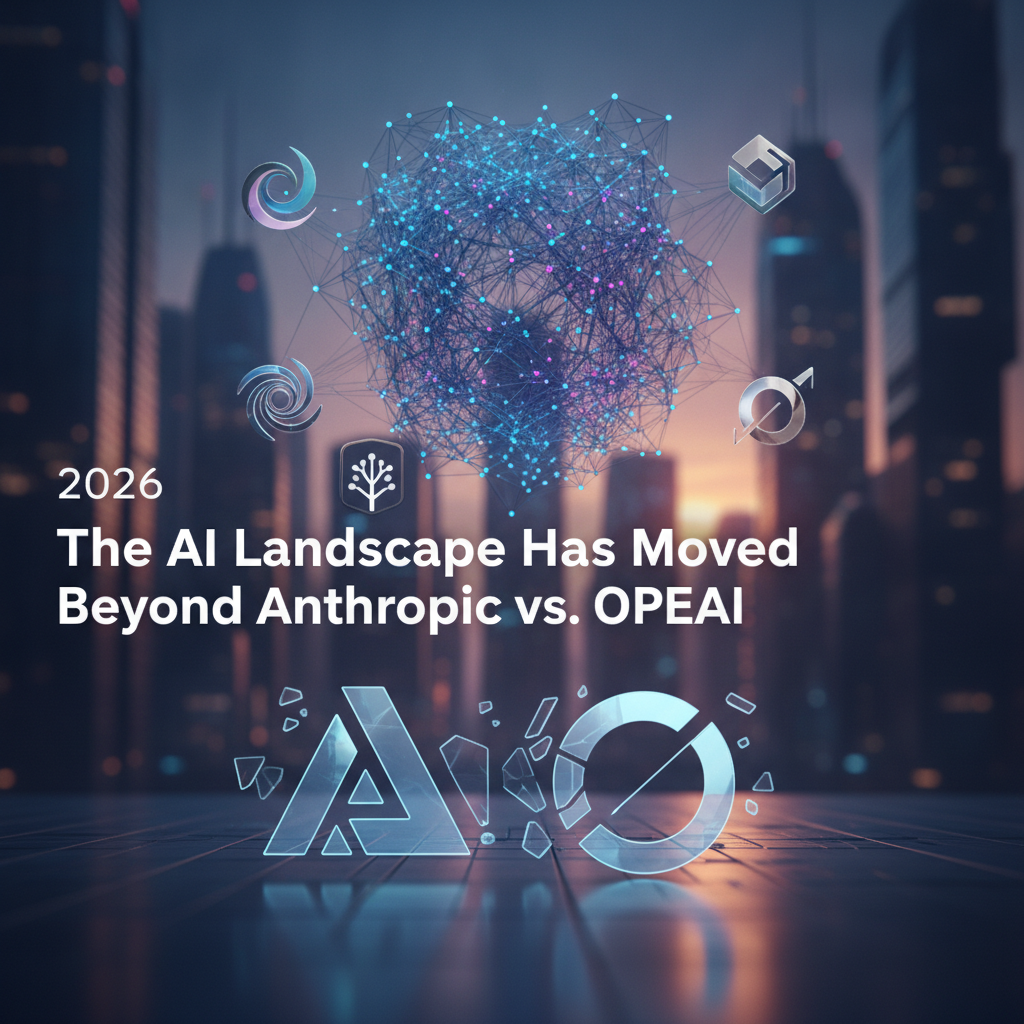
Remember the early days of the generative AI boom? The narrative was often simplified to a heavyweight clash: Anthropic vs. OpenAI. For a time, it was a compelling story of innovation, competitive ethics, and parallel paths, capturing headlines and venture capital attention. But as we navigate the mid-2020s, specifically in 2026, that once-dominant storyline feels… quaint. The AI landscape has matured, diversified, and expanded far beyond a simple duopoly. The new battleground is multifaceted, strategic, and far more complex.
The Rise of the AI Multiverse
By 2026, the ‘AI Multiverse’ is thriving. While OpenAI and Anthropic continue to innovate with their respective flagship models, pushing boundaries in general intelligence and safety-first approaches, they are no longer the sole gravitational centers. Google’s Gemini models, refined and integrated across its vast ecosystem, offer compelling alternatives. Meta’s open-source Llama family has empowered a vibrant developer community, democratizing access and fostering an explosion of specialized applications. Microsoft, through its deep integration of AI into everything from Azure to Copilot, has solidified its position as an infrastructure and application powerhouse. Even Amazon is making significant strides with Bedrock and its own model developments, targeting enterprise solutions.
Specialization and Vertical Integration Dominate
The race to build the ‘one model to rule them all’ has largely given way to a focus on specialization. Companies aren’t just looking for powerful general-purpose LLMs; they’re demanding models trained on proprietary data, optimized for specific tasks, and seamlessly integrated into their existing workflows. This has spurred a wave of vertical AI solutions, from legal AI that can draft contracts with unparalleled accuracy, to medical AI that assists in diagnostics and drug discovery, to creative AI that understands brand guidelines implicitly. The value now lies in the application layer, where AI becomes an invisible, indispensable co-pilot rather than a standalone tool. This shift demands a deeper understanding of industry nuances, pushing AI providers to either specialize or partner extensively.
The Open-Source Revolution Matures
Perhaps one of the most significant shifts by 2026 is the maturity of the open-source AI ecosystem. Models like Meta’s Llama derivatives, Mistral AI, and a growing array of other powerful open-source alternatives have fundamentally altered the competitive landscape. These models offer flexibility, transparency, and a cost-effective entry point for countless startups and enterprises. This explosion of open-source innovation has not only put pressure on proprietary model developers to demonstrate superior value and defensible moats but has also accelerated the pace of AI development across the board, making AI more accessible and adaptable than ever before. The community contributions to these models often outpace single-company efforts, leading to rapid feature development and bug fixes.
Infrastructure, Data, and Talent: The New Choke Points
As AI models become more commoditized and diverse, the true competitive differentiators in 2026 lie elsewhere: in access to computational infrastructure (particularly next-gen AI GPUs and specialized chips!), high-quality proprietary data, and the exceptionally scarce talent pool of AI engineers and researchers. The ability to efficiently train, fine-tune, and deploy AI at scale, coupled with unique datasets that provide an edge, has become paramount. Companies are battling for data scientists, ML engineers, and prompt engineers with the same fervor they once reserved for core model architects, understanding that execution, integration, and ethical deployment are now key. The strategic importance of cloud providers offering robust AI services has never been higher.
Ethics, Regulation, and Societal Impact Take Center Stage
The philosophical debates surrounding AI ethics have evolved into concrete regulatory frameworks by 2026. Governments worldwide are implementing rules around AI transparency, accountability, data privacy, and bias mitigation, with the EU’s AI Act serving as a global benchmark. Companies are no longer just building powerful AI; they’re building responsible AI. Trust, safety, and compliance are paramount, with dedicated AI ethics teams becoming standard practice. The broader societal impact of AI – from job displacement to misinformation and algorithmic fairness – is a constant, pressing conversation, demanding thoughtful innovation and robust safeguards from all players, not just a select few.
The New AI Reality
The narrative of Anthropic vs. OpenAI, while historically important, no longer captures the intricate, rapidly evolving reality of the AI industry in 2026. We’ve moved beyond a two-horse race to a sprawling ecosystem characterized by diverse players, specialized applications, open innovation, infrastructure battles, and a profound focus on ethical deployment. For businesses and innovators alike, understanding this complex, multi-faceted landscape is no longer optional – it’s the only path forward in the relentless pursuit of AI’s transformative potential.
Leave a Reply