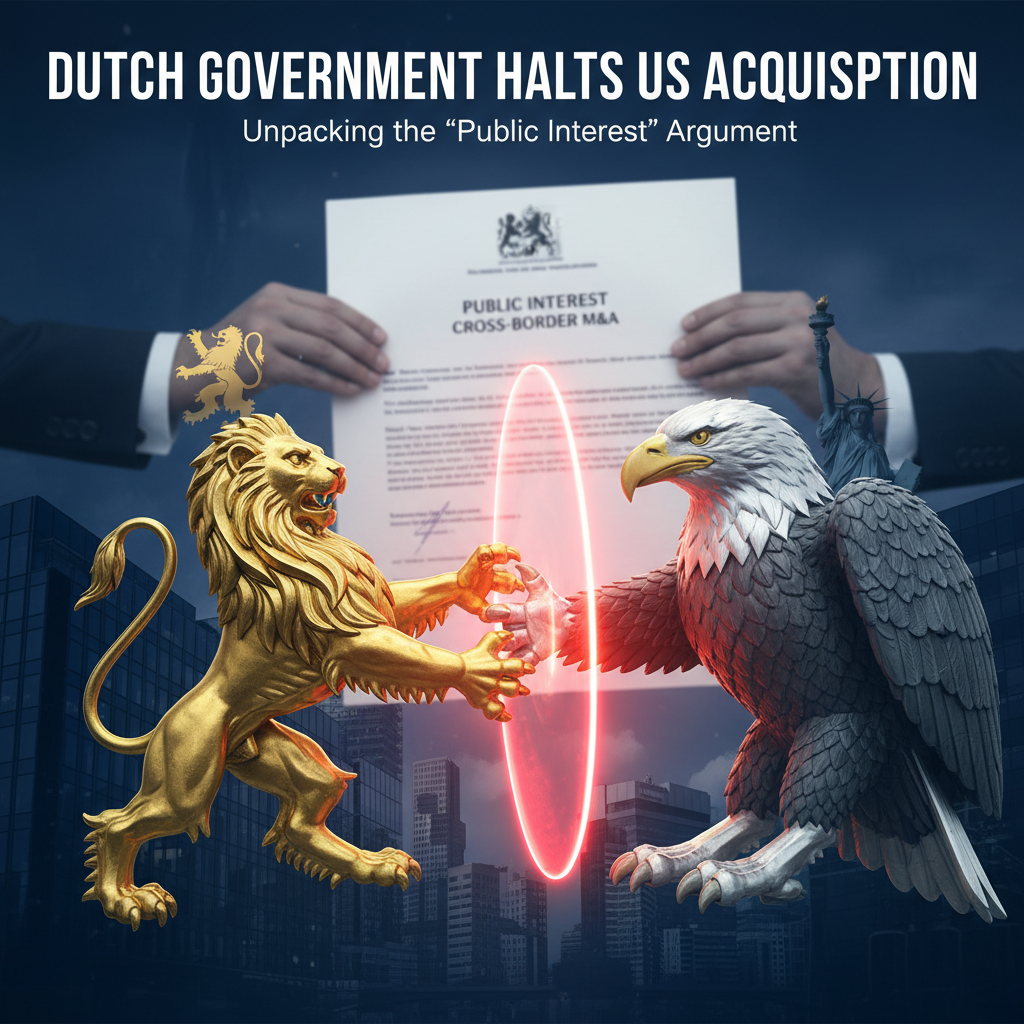
In a move signaling increased scrutiny on international mergers and acquisitions, the Dutch government recently blocked a significant acquisition attempt by a US-based company, citing potential ‘risk to public interest’. While the specific companies involved remain unnamed in the initial report, this development underscores a growing global trend: governments are asserting more control over foreign investments, particularly when national security, critical infrastructure, or strategic autonomy are perceived to be at stake.
This incident, reported as unfolding in 2026, serves as a powerful reminder for businesses and investors navigating the complex landscape of global M&A. The era of purely economically driven acquisitions is giving way to a more politically charged environment where ‘public interest’ is becoming a formidable gatekeeper.
The Rising Tide of Foreign Investment Screening
For years, many Western economies championed open markets and encouraged foreign direct investment (FDI). However, geopolitical tensions, technological advancements, and a sharpened focus on national resilience have led to a significant shift. Countries worldwide, including those within the European Union, have implemented or strengthened foreign investment screening mechanisms. These frameworks allow governments to review and potentially block acquisitions that could compromise national security or other vital public interests.
The Netherlands, a traditionally open economy, is no stranger to this trend. With the implementation of its Foreign Investment Screening Act (Wet Vifo), the Dutch government has equipped itself with powers to intervene in acquisitions within sensitive sectors, such as:
- Critical Infrastructure: Energy, telecommunications, ports, airports, and financial services.
- Sensitive Technology: Dual-use technology, semiconductors, quantum computing, and AI.
- Key Entities: Providers of vital services or managers of sensitive data.
What Does ‘Public Interest’ Really Mean?
The term ‘public interest’ can seem broad and, at times, ambiguous. However, in the context of foreign investment screening, it typically encompasses several key areas:
1. National Security
This is often the most direct and frequently cited reason for intervention. It includes protecting military capabilities, defense supply chains, intelligence gathering, and ensuring the resilience of critical infrastructure against sabotage or espionage.
2. Strategic Autonomy and Economic Security
Governments are increasingly concerned about losing control over essential industries or technologies to foreign entities. This can include maintaining domestic capacity in crucial sectors, preventing monopolies that could harm consumers, or ensuring diverse supply chains for vital goods and services.
3. Data Security and Privacy
With the digital economy booming, the ownership and control of vast amounts of citizen data are paramount. Acquisitions that could lead to data exfiltration, compromised data integrity, or access by adversarial states are under intense scrutiny.
4. Public Order and Essential Services
Ensuring the uninterrupted provision of essential services (e.g., healthcare, water, electricity) and maintaining public order can also fall under the ‘public interest’ umbrella. An acquisition that could destabilize these services is a clear red flag.
Implications for US Companies and Cross-Border M&A
For US companies looking to expand into European markets, or indeed any market with robust screening mechanisms, the Dutch government’s recent decision serves as a critical warning:
- Enhanced Due Diligence: It’s no longer enough to assess financial and legal risks. Companies must conduct thorough geopolitical and regulatory due diligence, identifying potential ‘public interest’ touchpoints in target acquisitions.
- Early Engagement: Proactive engagement with regulatory bodies and legal counsel in the target country is crucial. Understanding the local political climate and potential sensitivities can mitigate future roadblocks.
- Strategic Communication: Clearly articulating the benefits of an acquisition – not just financially, but also in terms of job creation, technological advancement, and contributions to the local economy – can help alleviate government concerns.
- Structural Considerations: Acquiring companies may need to consider alternative deal structures, commitments to local operations, or divestitures of sensitive assets to gain approval.
- Geopolitical Awareness: The origin of the acquiring company and its relationship with the target country’s government can play a significant role. Companies from certain regions might face more intense scrutiny than others.
Looking Ahead: A More Complex M&A Landscape
The Dutch government’s intervention highlights a broader trend towards a more protectionist and strategically driven approach to foreign investment across Europe and beyond. While the desire to safeguard national interests is understandable, it introduces additional layers of complexity and uncertainty for businesses operating in a globalized economy.
As we move further into the decade, companies engaging in cross-border M&A must remain agile, informed, and prepared to navigate a landscape where ‘public interest’ is a powerful, and increasingly exercised, governmental prerogative. Understanding this evolving framework will be key to successful international expansion.
Stay informed and consult with experts to ensure your M&A strategies are resilient in this new global environment.